
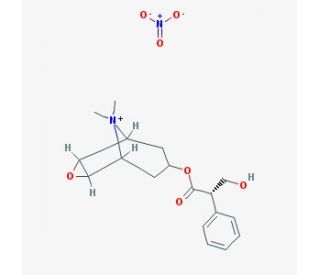

(−)Scopolamine methyl nitrate (CAS 6106-46-3)
QUICK LINKS
(−)Scopolamine methyl nitrate is a competitive antimuscarinic agent, blocking the binding of acetylcholine at mAChR M and preventing the opening of ion channels. (−)Scopolamine methyl nitrate is a versatile chemical compound extensively employed in scientific research for its broad range of applications. As a nitrate ester derived from the tertiary amine methscopolamine, it plays a role in numerous chemical processes. Its utility extends across various industries, including pharmaceuticals, agricultural chemicals, and food processing. Notably, (−)Scopolamine methyl nitrate offers several advantages, such as its cost-effectiveness, widespread availability, and remarkable stability. It serves as a valuable reagent for organic synthesis, an intermediate for synthesizing diverse compounds, and a valuable analytical tool. Additionally, it finds application in the exploration of enzyme kinetics and the investigation of drug metabolism.
(−)Scopolamine methyl nitrate (CAS 6106-46-3) References
- Peripheral involvement in nicotine-induced enhancement of ethanol intake. | Ericson, M., et al. 2000. Alcohol. 21: 37-47. PMID: 10946156
- Effects of biasing the location of stimulus presentation, and the muscarinic cholinergic receptor antagonist scopolamine, on performance of a 5-choice serial reaction time attention task in rats. | Shannon, HE. and Eberle, EL. 2006. Behav Pharmacol. 17: 71-85. PMID: 16377965
- Increased glial glutamate transporter EAAT2 expression reduces epileptogenic processes following pilocarpine-induced status epilepticus. | Kong, Q., et al. 2012. Neurobiol Dis. 47: 145-54. PMID: 22513140
- Status epilepticus alters hippocampal long-term synaptic potentiation in a rat lithium-pilocarpine model. | Kryukov, KA., et al. 2016. Neuroreport. 27: 1191-5. PMID: 27495218
- Synergistic action of CB1 and 5-HT2B receptors in preventing pilocarpine-induced status epilepticus in rats. | Colangeli, R., et al. 2019. Neurobiol Dis. 125: 135-145. PMID: 30716469
- Reactive pericytes in early phase are involved in glial activation and late-onset hypersusceptibility to pilocarpine-induced seizures in traumatic brain injury model mice. | Sakai, K., et al. 2021. J Pharmacol Sci. 145: 155-165. PMID: 33357774
- Preferential neuronal loss in layer III of the medial entorhinal cortex in rat models of temporal lobe epilepsy. | Du, F., et al. 1995. J Neurosci. 15: 6301-13. PMID: 7472396
- Intracerebroventricular pertussis toxin enhances sensitivity to chemical convulsants and decreases the protective efficacy of carbamazepine in mice. | Korolkiewicz, R., et al. 1996. Pharmacol Res. 33: 211-5. PMID: 8880893
Ordering Information
| Product Name | Catalog # | UNIT | Price | Qty | FAVORITES | |
(−)Scopolamine methyl nitrate, 1 g | sc-264301 | 1 g | $181.00 | |||
(−)Scopolamine methyl nitrate, 5 g | sc-264301A | 5 g | $525.00 |