
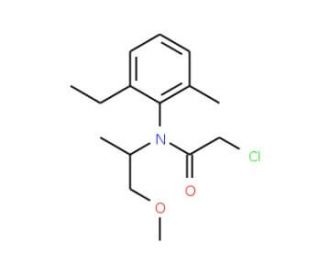

Metolachlor (CAS 51218-45-2)
QUICK LINKS
Metolachlor is frequently the subject of research in the field of agricultural chemistry due to its use as a herbicide. Studies focus on the mechanisms of action of Metolachlor at the molecular level, particularly how it inhibits protein synthesis in germinating weed seeds, thereby preventing their growth. Research also explores the environmental fate of Metolachlor, including its persistence in soil and water, its degradation products, and the factors influencing its degradation. Additionally, the impact of Metolachlor on non-target organisms is a significant area of investigation, aiming to understand its ecological effects. There is also considerable interest in developing methods to detect and quantify Metolachlor residues in environmental samples to monitor and mitigate its presence in agricultural settings.
Metolachlor (CAS 51218-45-2) References
- Metolachlor and chlorothalonil dissipation in gypsum-amended soil. | White, PM. and Potter, TL. 2010. J Environ Sci Health B. 45: 729-38. PMID: 20845184
- Herbicide metolachlor causes changes in reproductive endocrinology of male wistar rats. | Mathias, FT., et al. 2012. ISRN Toxicol. 2012: 130846. PMID: 23724293
- Identification of metolachlor mineralizing bacteria in aerobic and anaerobic soils using DNA-stable isotope probing. | Kanissery, RG., et al. 2018. Biodegradation. 29: 117-128. PMID: 29285669
- Dissipation of terbuthylazine, metolachlor, and mesotrione in soils with contrasting texture. | Carretta, L., et al. 2018. J Environ Sci Health B. 53: 661-668. PMID: 29842837
- Sunlight Photolysis of Safener Benoxacor and Herbicide Metolachlor as Mixtures on Simulated Soil Surfaces. | Su, L., et al. 2019. Environ Sci Technol. 53: 6784-6793. PMID: 31132254
- The metolachlor degradation kinetics and bacterial community evolution in the soil bioelectrochemical remediation. | Li, X., et al. 2020. Chemosphere. 248: 125915. PMID: 32007770
- Strong adsorption of metolachlor by biochar prepared from walnut shells in water. | Liu, L. and Dai, Y. 2021. Environ Sci Pollut Res Int. 28: 48379-48391. PMID: 33913108
- Bioaccumulation, metabolism and endocrine-reproductive effects of metolachlor and its S-enantiomer in adult zebrafish (Danio rerio). | Ou-Yang, K., et al. 2022. Sci Total Environ. 802: 149826. PMID: 34455281
- Adsorption of metolachlor by a novel magnetic illite-biochar and recovery from soil. | Liu, L., et al. 2022. Environ Res. 204: 111919. PMID: 34480949
- Effects of three surfactants on the degradation and environmental risk of metolachlor in aquatic environment. | Yi, X., et al. 2022. Chemosphere. 300: 134295. PMID: 35283146
- Degradation potential of MCPA, metolachlor and propiconazole in the hyporheic sediments of an agriculturally impacted river. | Bech, TB., et al. 2022. Sci Total Environ. 834: 155226. PMID: 35461929
- Metolachlor adsorption using walnut shell biochar modified by soil minerals. | Liu, L., et al. 2022. Environ Pollut. 308: 119610. PMID: 35700880
- Metolachlor metal-organic framework nanoparticles for reducing leaching, ecotoxicity and improving bioactivity. | Ren, L., et al. 2022. Pest Manag Sci. 78: 5366-5378. PMID: 36057859
- Trans enantiomeric separation of MESA and MOXA, two environmentally important metabolites of the herbicide, metolachlor. | Bianca, MR., et al. 2022. MethodsX. 9: 101884. PMID: 36325380
- Microplastic-Induced Oxidative Stress in Metolachlor-Degrading Filamentous Fungus Trichoderma harzianum. | Jasińska, A., et al. 2022. Int J Mol Sci. 23: PMID: 36361770
Ordering Information
| Product Name | Catalog # | UNIT | Price | Qty | FAVORITES | |
Metolachlor, 100 mg | sc-250406 | 100 mg | $53.00 |