
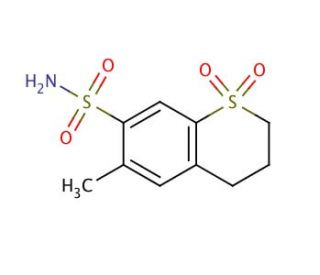

Molecular structure of Meticrane, CAS Number: 1084-65-7
Meticrane (CAS 1084-65-7)
See product citations (2)
Alternate Names:
6-Methyl-1-thia-1,2,3,4-tetrahydronaphthalene-7-sulfonamide 1,1-dioxide
CAS Number:
1084-65-7
Molecular Weight:
275.34
Molecular Formula:
C10H13NO4S2
For Research Use Only. Not Intended for Diagnostic or Therapeutic Use.
* Refer to Certificate of Analysis for lot specific data.
QUICK LINKS
Ordering Information
Product Citations
Description
Technical Information
Safety Information
SDS & Certificate of Analysis
Meticrane is a chemical compound that functions as a potent inhibitor of the enzyme adenosine deaminase. It acts by binding to the active site of the enzyme, preventing the conversion of adenosine to inosine. This inhibition disrupts the normal cellular processes that rely on adenosine metabolism, leading to a buildup of adenosine and a decrease in inosine levels. Meticrane′s function in experimental applications lies in its ability to manipulate adenosine metabolism and investigate the downstream effects on cellular signaling and biological pathways.
Meticrane (CAS 1084-65-7) References
- Phytoestrogens regulate the proliferation and expression of stem cell factors in cell lines of malignant testicular germ cell tumors. | Hasibeder, A., et al. 2013. Int J Oncol. 43: 1385-94. PMID: 23969837
- Multiparameter screening reveals a role for Na+ channels in cytokine-induced β-cell death. | Yang, YH., et al. 2014. Mol Endocrinol. 28: 406-17. PMID: 24438339
- Integrated analysis identifies interaction patterns between small molecules and pathways. | Li, Y., et al. 2014. Biomed Res Int. 2014: 931825. PMID: 25114931
- Network analysis of immunotherapy-induced regressing tumours identifies novel synergistic drug combinations. | Lesterhuis, WJ., et al. 2015. Sci Rep. 5: 12298. PMID: 26193793
- Identification of candidate drugs for the treatment of metastatic osteosarcoma through a subpathway analysis method. | Li, X., et al. 2017. Oncol Lett. 13: 4378-4384. PMID: 28599440
- An integrated meta-analysis approach to identifying medications with potential to alter breast cancer risk through connectivity mapping. | Thillaiyampalam, G., et al. 2017. BMC Bioinformatics. 18: 581. PMID: 29268695
- Identification of putative drugs for gastric adenocarcinoma utilizing differentially expressed genes and connectivity map. | Chen, ZX., et al. 2019. Mol Med Rep. 19: 1004-1015. PMID: 30569111
- Targeting Penicillium expansum GMC Oxidoreductase with High Affinity Small Molecules for Reducing Patulin Production. | Tragni, V., et al. 2020. Biology (Basel). 10: PMID: 33396459
- LPCAT1 overexpression promotes the progression of hepatocellular carcinoma. | He, RQ., et al. 2021. Cancer Cell Int. 21: 442. PMID: 34419067
- Identification of HCC Subtypes With Different Prognosis and Metabolic Patterns Based on Mitophagy. | Wang, Y., et al. 2021. Front Cell Dev Biol. 9: 799507. PMID: 34977039
- Targeting non-structural proteins of Hepatitis C virus for predicting repurposed drugs using QSAR and machine learning approaches. | Kamboj, S., et al. 2022. Comput Struct Biotechnol J. 20: 3422-3438. PMID: 35832613
- Development and validation of an epithelial-mesenchymal transition-related gene signature for predicting prognosis. | Zhou, DH., et al. 2022. World J Clin Cases. 10: 9285-9302. PMID: 36159424
- DeepsmirUD: Prediction of Regulatory Effects on microRNA Expression Mediated by Small Molecules Using Deep Learning. | Sun, J., et al. 2023. Int J Mol Sci. 24: PMID: 36768205
- De Novo Design of Anti-COVID Drugs Using Machine Learning-Based Equivariant Diffusion Model Targeting the Spike Protein. | Niranjan, V., et al. 2023. Curr Issues Mol Biol. 45: 4261-4284. PMID: 37232740
- Non-oncology drug (meticrane) shows anti-cancer ability in synergy with epigenetic inhibitors and appears to be involved passively in targeting cancer cells. | Wang, Y., et al. 2023. Front Oncol. 13: 1157366. PMID: 37274234
Ordering Information
| Product Name | Catalog # | UNIT | Price | Qty | FAVORITES | |
Meticrane, 5 g | sc-224097 | 5 g | $79.00 |