
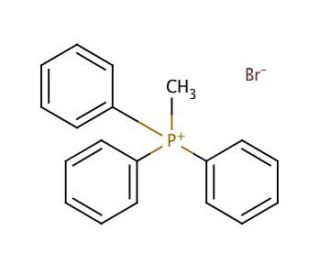

Methyltriphenylphosphonium bromide (CAS 1779-49-3)
QUICK LINKS
Methyltriphenylphosphonium bromide is a quaternary phosphonium salt that functions as a phase-transfer catalyst in organic synthesis. Its mechanism of action involves facilitating the transfer of a reactant from one phase to another, typically from an aqueous phase to an organic phase, by forming a complex with the reactant and transporting it across the phase boundary. This allows for reactions between substances that are normally immiscible, enabling the synthesis of various organic compounds. Methyltriphenylphosphonium bromide achieves this by effectively solubilizing the reactants in the organic phase, thereby increasing the reaction rate and yield. Its ability to promote the transfer of ions and molecules between phases may be useful in the development of new chemical processes and the production of complex organic molecules.
Methyltriphenylphosphonium bromide (CAS 1779-49-3) References
- Determination of bismuth in pharmaceutical products using methyltriphenylphosphonium bromide as a molecular probe by resonance light scattering technique. | Cui, F., et al. 2007. J Pharm Biomed Anal. 43: 1033-8. PMID: 17184952
- Synthesis of a polymerizable fluorosurfactant for the construction of stable nanostructured proton-conducting membranes. | Wadekar, MN., et al. 2010. J Org Chem. 75: 6814-9. PMID: 20845981
- Deep eutectic solvent-assisted synthesis of biodegradable polyesters with antibacterial properties. | García-Argüelles, S., et al. 2013. Langmuir. 29: 9525-34. PMID: 23808373
- Applicability evaluation of Deep Eutectic Solvents-Cellulase system for lignocellulose hydrolysis. | Gunny, AA., et al. 2015. Bioresour Technol. 181: 297-302. PMID: 25661309
- Exploration of a ternary deep eutectic solvent of methyltriphenylphosphonium bromide/chalcone/formic acid for the selective recognition of rutin and quercetin in Herba Artemisiae Scopariae. | Ma, W., et al. 2017. J Sep Sci. 40: 3248-3256. PMID: 28631409
- Molecular Dynamic Simulations for the Extraction of Quinoline from Heptane in the Presence of a Low-Cost Phosphonium-Based Deep Eutectic Solvent. | Naik, PK., et al. 2018. J Phys Chem B. 122: 4006-4015. PMID: 29543459
- Synthesis of the chiral selector heptakis(6-O-methyl)-β-cyclodextrin by phase-transfer catalysis and hydrazine-mediated transfer-hydrogenation. | Bálint, M., et al. 2019. Electrophoresis. 40: 1941-1950. PMID: 30892708
- Structure and properties of two glucose-based deep eutectic systems. | Bergua, F., et al. 2021. Food Chem. 336: 127717. PMID: 32763740
- Polyethylene glycol-based deep eutectic solvents as a novel agent for natural gas sweetening. | Aldawsari, JN., et al. 2020. PLoS One. 15: e0239493. PMID: 32956424
- Alkylation of quinoxalin-2(1H)-ones using phosphonium ylides as alkylating reagents. | Peng, S., et al. 2021. Org Biomol Chem. 19: 9705-9710. PMID: 34726225
- Solvent Regeneration Methods for Combined Dearomatization, Desulfurization, and Denitrogenation of Fuels Using Deep Eutectic Solvents. | Abu Hatab, F., et al. 2023. ACS Omega. 8: 626-635. PMID: 36643525
- A phosphonium-based deep eutectic solvent promotes the stereoselective semi-reduction of internal alkynes to (Z)-alkenes. | Paparella, AN., et al. 2023. Org Biomol Chem. 21: 3770-3777. PMID: 37078606
- Transport and incorporation of N-acetyl-D-glucosamine in Bacillus subtilis. | Mobley, HL., et al. 1982. J Bacteriol. 150: 8-15. PMID: 6174502
Ordering Information
| Product Name | Catalog # | UNIT | Price | Qty | FAVORITES | |
Methyltriphenylphosphonium bromide, 25 g | sc-253045 | 25 g | $24.00 | |||
Methyltriphenylphosphonium bromide, 100 g | sc-253045A | 100 g | $66.00 |