
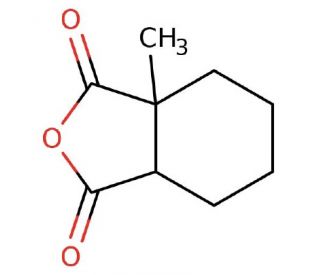

Methylhexahydrophthalic Anhydride (CAS 25550-51-0)
QUICK LINKS
Methylhexahydrophthalic Anhydride, often found in the field of materials science, is used in the synthesis of various polymers and resins. Researchers employ this compound to study the properties and behaviors of epoxy resins where it acts as a hardener, contributing to the thermal and mechanical characteristics of the final product. The anhydride group in Methylhexahydrophthalic Anhydride reacts with epoxide groups, making it valuable in experiments aiming to enhance the durability and longevity of cured polymers. Its role in the production of coatings, adhesives, and composite materials is also a subject of research, aiming to optimize performance in industrial applications. Additionally, investigations into the kinetics and mechanisms of its reaction with other organic compounds provide insights into the design of more efficient manufacturing processes.
Methylhexahydrophthalic Anhydride (CAS 25550-51-0) References
- Airborne allergic contact urticaria from methylhexahydrophthalic anhydride and hexahydrophthalic anhydride. | Kanerva, L., et al. 1999. Contact Dermatitis. 41: 339-41. PMID: 10617215
- Quantification of protein adducts of hexahydrophthalic anhydride and methylhexahydrophthalic anhydride in human plasma. | Rosqvist, S., et al. 2000. J Environ Monit. 2: 155-60. PMID: 11253036
- Occupational contact urticaria caused by airborne methylhexahydrophthalic anhydride. | Yokota, K., et al. 2001. Ind Health. 39: 347-52. PMID: 11758999
- Exposure-response relationships for hexahydrophthalic and methylhexahydrophthalic anhydrides with total plasma protein adducts as biomarkers. | Rosqvist, S., et al. 2003. Scand J Work Environ Health. 29: 297-303. PMID: 12934723
- Exposure to methylhexahydrophthalic anhydride (MHHPA) in two workplaces of the electric industry. | Pfäffli, P., et al. 2004. J Environ Monit. 6: 295-9. PMID: 15054537
- Methylhexahydrophthalic anhydride adducted albumin tryptic peptides in nasal lavage fluid. | Jeppsson, MC., et al. 2009. Inhal Toxicol. 21: 1013-20. PMID: 19772480
- High Performance Shape Memory Epoxy/Carbon Nanotube Nanocomposites. | Liu, Y., et al. 2016. ACS Appl Mater Interfaces. 8: 311-20. PMID: 26641129
- Tannic Acid as a Bio-Based Modifier of Epoxy/Anhydride Thermosets. | Fei, X., et al. 2016. Polymers (Basel). 8: PMID: 30974594
- Novel Siloxane-Modified Epoxy Resins as Promising Encapsulant for LEDs. | Lin, CH., et al. 2019. Polymers (Basel). 12: PMID: 31861947
- Immunologic contact urticaria due to airborne methylhexahydrophthalic and methyltetrahydrophthalic anhydrides. | Tarvainen, K., et al. 1995. Contact Dermatitis. 32: 204-9. PMID: 7600775
- Delayed and immediate allergy caused by methylhexahydrophthalic anhydride. | Kanerva, L., et al. 1997. Contact Dermatitis. 36: 34-8. PMID: 9034685
- Quantification method of human hemoglobin adducts from hexahydrophthalic anhydride and methylhexahydrophthalic anhydride. | Lindh, CH. and Jönsson, BA. 1998. J Chromatogr B Biomed Sci Appl. 710: 81-90. PMID: 9686874
- Human hemoglobin adducts following exposure to hexahydrophthalic anhydride and methylhexahydrophthalic anhydride. | Lindh, CH. and Jönsson, BA. 1998. Toxicol Appl Pharmacol. 153: 152-60. PMID: 9878586
Ordering Information
| Product Name | Catalog # | UNIT | Price | Qty | FAVORITES | |
Methylhexahydrophthalic Anhydride, 1 g | sc-338055A | 1 g | $109.00 | |||
Methylhexahydrophthalic Anhydride, 10 g | sc-338055 | 10 g | $588.00 |