
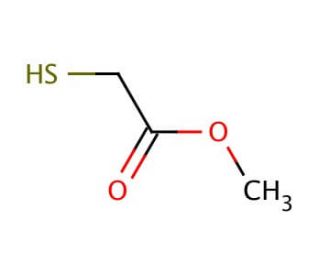

Methyl thioglycolate (CAS 2365-48-2)
QUICK LINKS
Methyl thioglycolate is a thiol organocatalyst used in conjunction with visible light photocatalysis to affect the direct arylation of benzylic ether C-H bonds. Methyl thioglycolate (MTG) stands as an organic compound composed of sulfur, carbon, and oxygen, characterized by its molecular formula C3H6O2S. This colorless liquid emits a sharp odor and demonstrates solubility in water, alcohol, and various organic solvents. Methyl thioglycolate finds application as a valuable reagent in organic synthesis, a catalyst driving polymer production, and even as a preservative enhancing the longevity of food products. Moreover, Methyl thioglycolate has proven its significance in diverse scientific research endeavors. It has notably contributed to polymer synthesis as well as the creation of cosmetics and textiles. Functioning as both a reagent in organic synthesis and a catalyst for polymer production, Methyl thioglycolate further lends its effectiveness as a food preservative. Notably, its reducing agent properties enable it to lower the oxidation state of various molecules, while also assuming the role of an acid-base catalyst, thereby facilitating the transfer of protons from one molecule to another.
Methyl thioglycolate (CAS 2365-48-2) References
- Thiyl radical mediated racemization of nonactivated aliphatic amines. | Escoubet, S., et al. 2006. J Org Chem. 71: 7288-92. PMID: 16958522
- Reductive and nucleophilic activation products of dynemicin A with methyl thioglycolate. A rational mechanism for DNA cleavage of the thiol-activated dynemicin A. | Sugiura, Y., et al. 1991. Biochemistry. 30: 2989-92. PMID: 2007134
- On the mechanism of toxicity of illudins: the role of glutathione. | McMorris, TC., et al. 1990. Chem Res Toxicol. 3: 574-9. PMID: 2103329
- Ligand-controlled growth of ZnSe quantum dots in water during Ostwald ripening. | Jiang, F. and Muscat, AJ. 2012. Langmuir. 28: 12931-40. PMID: 22881121
- Microwave-assisted synthesis of 3-aminobenzo[b]thiophene scaffolds for the preparation of kinase inhibitors. | Bagley, MC., et al. 2015. Org Biomol Chem. 13: 6814-24. PMID: 26013834
- Facile and High-Yielding Synthesis of TAM Biradicals and Monofunctional TAM Radicals. | Trukhin, DV., et al. 2016. Synlett. 27: 893-899. PMID: 27065567
- Synthesis of l- and d-Ubiquitin by One-Pot Ligation and Metal-Free Desulfurization. | Huang, YC., et al. 2016. Chemistry. 22: 7623-8. PMID: 27075969
- Hyperbranched Aliphatic Polyester via Cross-Metathesis Polymerization: Synthesis and Postpolymerization Modification. | Zeng, FR., et al. 2018. Macromol Rapid Commun. 39: PMID: 29250866
- Synthesis of aryl-substituted thieno[3,2-b]thiophene derivatives and their use for N,S-heterotetracene construction. | Demina, NS., et al. 2019. Beilstein J Org Chem. 15: 2678-2683. PMID: 31807203
- Chemoenzymatic Semi-synthesis Enables Efficient Production of Isotopically Labeled α-Synuclein with Site-Specific Tyrosine Phosphorylation. | Pan, B., et al. 2021. Chembiochem. 22: 1440-1447. PMID: 33274519
- Remote Site-Selective Radical C(sp3)-H Monodeuteration of Amides using D2 O. | Wang, L., et al. 2021. Angew Chem Int Ed Engl. 60: 18645-18650. PMID: 34114304
- Allyl group-containing polyvinylphosphonates as a flexible platform for the selective introduction of functional groups via polymer-analogous transformations. | Halama, K., et al. 2021. RSC Adv. 11: 38555-38564. PMID: 35493229
- Addition of methyl thioglycolate and benzylamine to (Z)-ligustilide, a bioactive unsaturated lactone constituent of several herbal medicines. An improved synthesis of (Z)-ligustilide. | Beck, JJ. and Stermitz, FR. 1995. J Nat Prod. 58: 1047-55. PMID: 7561898
Ordering Information
| Product Name | Catalog # | UNIT | Price | Qty | FAVORITES | |
Methyl thioglycolate, 25 g | sc-235845 | 25 g | $20.00 | |||
Methyl thioglycolate, 100 g | sc-235845A | 100 g | $19.00 |