
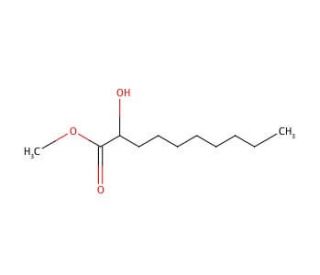

Methyl (±)-2-hydroxydecanoate (CAS 71271-24-4)
QUICK LINKS
Methyl (±)-2-hydroxydecanoate is a chiral ester derivative of hydroxy fatty acids that has been extensively studied for its role in lipid chemistry and its potential applications in materials science. This compound is primarily used in research to investigate the enzymatic activity of esterases and lipases, enzymes that catalyze the hydrolysis of ester bonds. It serves as a model substrate in studies examining enzyme specificity, kinetics, and mechanisms. In addition, methyl (±)-2-hydroxydecanoate is utilized in the synthesis of biodegradable polymers and surfactants due to its favorable physicochemical properties. Researchers have explored its incorporation into polymer matrices to enhance biodegradability and mechanical strength, making it a valuable component in developing sustainable materials. The esterification of 2-hydroxydecanoic acid also facilitates studies on stereoselective synthesis and chiral resolution, contributing to a better understanding of asymmetric catalysis. Recent research has focused on its role in microbial metabolism, where certain bacteria can utilize methyl (±)-2-hydroxydecanoate as a carbon source, shedding light on metabolic pathways and microbial ecology. The compound′s versatility and significance in enzymology, materials science, and microbiology underscore its importance in advancing both fundamental and applied research.
Methyl (±)-2-hydroxydecanoate (CAS 71271-24-4) References
- Removal of dissolved organic carbon and nitrogen during simulated soil aquifer treatment. | Essandoh, HM., et al. 2013. Water Res. 47: 3559-72. PMID: 23726692
- Changes in volatile compounds and some physicochemical properties of European cranberrybush (Viburnum opulus L.) during ripening through traditional fermentation. | Yilmaztekin, M. and Sislioglu, K. 2015. J Food Sci. 80: C687-94. PMID: 25808206
- cis-9,10-epoxystearic acid in human leukocytes: isolation and quantitative determination. | Fahlstadius, P. 1988. Lipids. 23: 1015-8. PMID: 3237000
- Effect of Culture Conditions on Fatty Acid Profiles of Bacteria and Lipopolysaccharides of the Genus Pseudomonas-GC-MS Analysis on Ionic Liquid-Based Column. | Mező, E., et al. 2022. Molecules. 27: PMID: 36296523
- All (S) stereoconfiguration of 7,10-dihydroxy-8(E)-octadecenoic acid from bioconversion of oleic acid by Pseudomonas aeruginosa | Harold W. Gardner, Ching T. Hou. 1999. Journal of the American Oil Chemists' Society. 76: 1151-1156.
- 10(S)-Hydroxy-8(E)-octadecenoic acid, an intermediate in the conversion of oleic acid to 7,10-dihydroxy-8(E)-octadecenoic acid | Hakryul Kim, Harold W. Gardner & Ching T. Hou. 2000. Journal of the American Oil Chemists' Society. 77: 95–99.
- Glycolipids of the filamentous fungus Absidia corymbifera F-295 | Batrakov, S. G., et al. 2003. Chemistry and Physics of Lipids. 123: 157-164.
Ordering Information
| Product Name | Catalog # | UNIT | Price | Qty | FAVORITES | |
Methyl (±)-2-hydroxydecanoate, 10 mg | sc-215311 | 10 mg | $30.00 | |||
Methyl (±)-2-hydroxydecanoate, 100 mg | sc-215311A | 100 mg | $236.00 |