
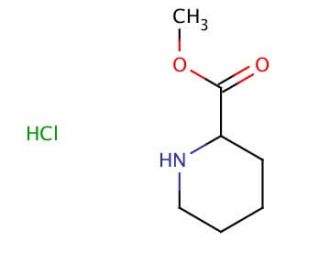

Methyl pipecolinate hydrochloride (CAS 32559-18-5)
QUICK LINKS
Methyl pipecolinate hydrochloride is a chemical compound that features a pipecolic acid structure (a six-membered nitrogen-containing heterocycle) esterified with a methyl group and subsequently combined with hydrochloride to form the salt. This structure is intriguing to researchers due to its resemblance to pipecolic acid derivatives, which are important in various biochemical pathways and synthetic chemistry applications. The primary mechanism of action for methyl pipecolinate hydrochloride in research involves its role as a synthetic intermediate. It serves as a versatile building block in the synthesis of more complex organic compounds. Specifically, its pipecolate core is similar to proline and pipecolic acid, which are found in many bioactive molecules, making it a valuable precursor in the synthesis of peptides, alkaloids, and cyclic compounds. In the field of organic chemistry, methyl pipecolinate hydrochloride is used to study the synthesis of various cyclic and heterocyclic compounds. Researchers utilize this compound to explore new synthetic routes and to understand how substituents like the methyl ester group affect chemical reactivity and stability. The hydrochloride salt form improves the solubility in polar solvents, enhancing its usability in various reactions. Additionally, methyl pipecolinate hydrochloride has been used in studies related to enzyme mimicry and catalysis. The pipecolic structure is particularly interesting because it can mimic the transition states of certain biochemical reactions, especially those involving proline and pipecolic acid derivatives. By studying how this compound interacts with catalytic sites, researchers can design better catalysts and understand the fundamental principles of biological catalysis.
Methyl pipecolinate hydrochloride (CAS 32559-18-5) References
- Azomethine ylide cycloaddition: a versatile tool for preparing novel pyrrolizidino-spiro-oxindolo hybrids of the doubly conjugated alkamide piperine. | Singh, M., et al. 2020. Mol Divers. 24: 627-639. PMID: 31183672
- Investigation of Grignard Reagent as an Advanced Base for Aza-Claisen Rearrangement. | Song, BR., et al. 2019. Molecules. 24: PMID: 31888158
- N-Hydroxy pipecolic acid methyl ester is involved in Arabidopsis immunity. | Mohnike, L., et al. 2023. J Exp Bot. 74: 458-471. PMID: 36260503
- Design of novel water-soluble isoxazole-based antimicrobial agents and evaluation of their cytotoxicity and acute toxicity. | Kondrashov, EV., et al. 2023. Bioorg Chem. 138: 106644. PMID: 37302315
- Enantioselective lipase-catalyzed reactions of methyl pipecolinate: transesterification and N-acylation | Liljeblad, Arto, et al. 2002. Tetrahedron letters. 43: 2471-2474.
- Aldehyde-based racemization in the dynamic kinetic resolution of N-heterocyclic α-amino esters using Candida antarctica lipase A | Liljeblad, Arto, Anu Kiviniemi, and Liisa T. Kanerva. 2004. Tetrahedron. 60: 671-677.
- The α-effect in cyclic secondary amines: new scaffolds for iminium ion accelerated transformations. | Brazier, John B., et al. 2009. Tetrahedron. 65: 9961-9966.
- Advances in the kinetic and dynamic kinetic resolution of piperazine-2-carboxylic acid derivatives with Candida antarctica lipase A; structural requirements for enantioselective N-acylation | Hietanen, Ari, et al. 2012. Online Journal of Organic Chemistry.
- Multicomponent Diastereoselective Synthesis of Indolizidines via 1, 3-Dipolar Cycloadditions of Azomethine Ylides | Castello, Luis M., et al. 2017. Synthesis. 49: 299-309.
Ordering Information
| Product Name | Catalog # | UNIT | Price | Qty | FAVORITES | |
Methyl pipecolinate hydrochloride, 5 g | sc-235841 | 5 g | $26.00 |