
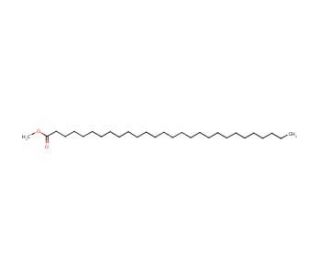

Methyl octacosanoate (CAS 55682-92-3)
LINKS RÁPIDOS
O octacosanoato de metilo, um éster metílico de cadeia longa, tem atraído a atenção da investigação científica pelas suas potenciais aplicações em vários domínios. A sua estrutura química, que inclui um grupo metilo ligado a uma cadeia de ácidos gordos saturados com 28 carbonos, oferece propriedades únicas que conduzem a diversos trabalhos de investigação. Na lipidómica, o octacosanoato de metilo serve de composto modelo para estudar o metabolismo e as propriedades biofísicas dos ácidos gordos de cadeia longa, contribuindo para uma compreensão mais profunda do metabolismo dos lípidos em contextos celulares e fisiológicos. Além disso, a sua utilização na ciência dos materiais tem sido explorada, particularmente na síntese de revestimentos e películas biocompatíveis para aplicações biomédicas e industriais. Os investigadores investigaram o seu papel como aditivo lubrificante, melhorando as propriedades lubrificantes de óleos e massas lubrificantes em sistemas mecânicos. Além disso, o octacosanoato de metilo tem encontrado utilidade na síntese orgânica como um bloco de construção versátil para a preparação de moléculas complexas, facilitando o desenvolvimento de novos materiais e compostos. A sua natureza multifacetada faz do octacosanoato de metilo uma ferramenta valiosa na investigação científica, com aplicações que vão desde a lipidómica e a ciência dos materiais até à síntese orgânica e à tecnologia de lubrificação.
Methyl octacosanoate (CAS 55682-92-3) Referencias
- Monoglicéridos e ácidos gordos da raiz de Ibervillea sonorae: isolamento e atividade hipoglicémica. | Hernández-Galicia, E., et al. 2007. Planta Med. 73: 236-40. PMID: 17318782
- Constituintes químicos com atividade antibacteriana de Euphorbia sororia. | Zhang, WK., et al. 2008. Nat Prod Res. 22: 353-9. PMID: 18322851
- Especificidade do 1-triacontanol como estimulador do crescimento vegetal e inibição do seu efeito por outros compostos de cadeia longa. | Jones, J., et al. 1979. Planta. 144: 277-82. PMID: 24407259
- Avaliação dos constituintes químicos da casca do caule da Mimosa caesalpiniifolia: possíveis componentes bioactivos responsáveis pelo efeito citotóxico da M. caesalpiniifolia em linhas celulares tumorais humanas. | Monção, NB., et al. 2015. Molecules. 20: 4204-24. PMID: 25751783
- Síntese dos ácidos ω9-tetracosinóico e ω9-octacosinóico como entradas em precursores metabólicos tritiados decis-9-tricoseno ecis-9-heptacoseno na mosca doméstica. | George Pomonis, J. and Hakk, H. 1990. Lipids. 25: 821-6. PMID: 27520687
- Comparação de três métodos para a metilação de compostos alifáticos e aromáticos. | Lee, H., et al. 2017. Rapid Commun Mass Spectrom. 31: 1633-1640. PMID: 28763166
- Identificação de ésteres metílicos de ácidos gordos de cadeia muito longa (>C24) por cromatografia gasosa acoplada à espetrometria de massa quadrupolo/tempo de voo com fonte de ionização química à pressão atmosférica. | Garlito, B., et al. 2019. Anal Chim Acta. 1051: 103-109. PMID: 30661606
- Perfil de alto rendimento de fenótipos metabólicos utilizando GC-MS de alta resolução. | Wase, N., et al. 2022. Methods Mol Biol. 2539: 235-260. PMID: 35895208
- Novos ácidos gordos fosfolípidos bromados da esponja das Caraíbas Petrosia sp. | Carballeira, NM. and Shalabi, F. 1993. J Nat Prod. 56: 739-46. PMID: 8326322
- As entalpias de vaporização e as pressões de vapor dos ésteres metílicos de ácidos gordos C18, C21 a C23 e C25 a C29 por cromatografia de gás de correlação. | Chickos, et al. 2004. Thermochimica acta. 424.1-2: 111-121.
Informacoes sobre ordens
| Nome do Produto | Numero de Catalogo | UNID | Preco | Qde | FAVORITOS | |
Methyl octacosanoate, 250 mg | sc-211888 | 250 mg | $99.00 |