
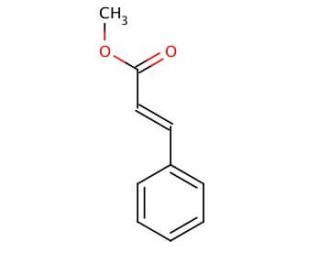

Methyl cinnamate (CAS 103-26-4)
QUICK LINKS
Methyl cinnamate (MC) stands as an alkyl ester of cinnamic acid, widely embraced for its role as a food additive and flavor enhancer. Displaying a colorless to pale yellow hue, this liquid emits a pleasant balsamic fragrance. Furthermore, its application in laboratory investigations has witnessed a recent surge due to its distinct attributes. While the precise workings of Methyl cinnamate remain partially obscured, it is believed to operate through diverse pathways. Notably, it can suppress the activity of cyclooxygenase-2 (COX-2), an enzyme linked to inflammation. It also curbs the activity of nuclear factor-kappa B (NF-κB), a transcription factor pivotal in regulating inflammation and cellular survival. Additionally, MC has the capacity to trigger apoptosis in cancer cells by activating caspase-3, an enzyme central to programmed cell death.
Methyl cinnamate (CAS 103-26-4) References
- Fragrance material review on methyl cinnamate. | Bhatia, SP., et al. 2007. Food Chem Toxicol. 45 Suppl 1: S113-9. PMID: 18037211
- Tricholoma matsutake 1-Ocen-3-ol and methyl cinnamate repel mycophagous Proisotoma minuta (Collembola: Insecta). | Sawahata, T., et al. 2008. Mycorrhiza. 18: 111-4. PMID: 18066606
- Methyl cinnamate inhibits adipocyte differentiation via activation of the CaMKK2-AMPK pathway in 3T3-L1 preadipocytes. | Chen, YY., et al. 2012. J Agric Food Chem. 60: 955-63. PMID: 22273148
- Optimization of antimicrobial and physical properties of alginate coatings containing carvacrol and methyl cinnamate for strawberry application. | Peretto, G., et al. 2014. J Agric Food Chem. 62: 984-90. PMID: 24405047
- Antispasmodic and myorelaxant effects of the flavoring agent methyl cinnamate in gut: potential inhibition of tyrosine kinase. | Lima, FJ., et al. 2014. Eur J Pharmacol. 740: 192-9. PMID: 25046838
- Evaluation of larvicidal activity and ecotoxicity of linalool, methyl cinnamate and methyl cinnamate/linalool in combination against Aedes aegypti. | Fujiwara, GM., et al. 2017. Ecotoxicol Environ Saf. 139: 238-244. PMID: 28152405
- Cinnamaldehyde in diabetes: A review of pharmacology, pharmacokinetics and safety. | Zhu, R., et al. 2017. Pharmacol Res. 122: 78-89. PMID: 28559210
- Interaction of cinnamic acid and methyl cinnamate with bovine serum albumin: A thermodynamic approach. | Nunes, NM., et al. 2017. Food Chem. 237: 525-531. PMID: 28764029
- Methyl cinnamate alleviated CCI-induced upregualtion of spinal AMPA receptors and pain hypersensitivity by targeting AMPK. | Gui, Y., et al. 2018. Eur J Pharmacol. 833: 183-189. PMID: 29802834
- trans-Cinnamic acid, but not p-coumaric acid or methyl cinnamate, induces fibroblast migration through PKA- and p38-MAPK signalling pathways. | Aquino, FLT., et al. 2021. J Tissue Viability. 30: 363-371. PMID: 34052086
- Extraction of essential oil from methyl cinnamate basil (Ocimum canum Sims) with high yield in a short time using enzyme pretreatment. | Morsy, NFS. and Hammad, KSM. 2021. J Food Sci Technol. 58: 2599-2605. PMID: 34194095
- An overview of the chemical composition and biological activities of essential oils from Alpinia genus (Zingiberaceae). | Van, HT., et al. 2021. RSC Adv. 11: 37767-37783. PMID: 35498079
- De Novo Biosynthesis of Methyl Cinnamate in Engineered Escherichia coli. | Guo, D., et al. 2022. J Agric Food Chem. 70: 7736-7741. PMID: 35709502
- Cinnamaldehyde microcapsules enhance bioavailability and regulate intestinal flora in mice. | Xiao, Y., et al. 2022. Food Chem X. 15: 100441. PMID: 36132744
- Methyl cinnamate derivatives enhance UV-induced mutagenesis due to the inhibition of DNA excision repair in Escherichia coli B/r. | Shimoi, K., et al. 1985. Mutat Res. 146: 15-22. PMID: 3889605
Ordering Information
| Product Name | Catalog # | UNIT | Price | Qty | FAVORITES | |
Methyl cinnamate, 100 g | sc-235815 | 100 g | $27.00 |