
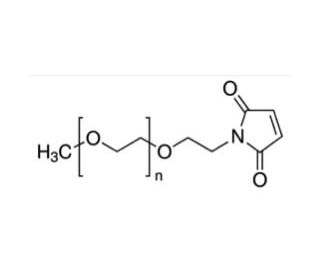

Methoxypolyethylene glycol maleimide (CAS 99126-64-4)
QUICK LINKS
Methoxypolyethylene glycol maleimide (mPEG-Mal) serves as a pivotal reagent in the field of bioconjugation chemistry, facilitating the attachment of polyethylene glycol (PEG) chains to molecules, with a particular emphasis on proteins. This process, known as PEGylation, enhances the solubility and stability of proteins, significantly extending their presence and function within research environments. The maleimide group of Methoxypolyethylene glycol maleimide reacts specifically with thiol groups (–SH) found on cysteine residues in proteins, forming stable thioether bonds. This specificity allows for controlled modification of proteins without altering their biological activity, making Methoxypolyethylene glycol maleimide an invaluable tool in the development of protein-based assays and in the study of protein dynamics and interactions. Its role in research extends beyond mere chemical modification, contributing to advancements in the understanding of protein behavior in various biological applications.
Methoxypolyethylene glycol maleimide (CAS 99126-64-4) References
- Development of a sensitive assay to detect reversibly oxidized protein cysteine sulfhydryl groups. | Makmura, L., et al. 2001. Antioxid Redox Signal. 3: 1105-18. PMID: 11813984
- Tertiary interactions within the ribosomal exit tunnel. | Kosolapov, A. and Deutsch, C. 2009. Nat Struct Mol Biol. 16: 405-11. PMID: 19270700
- Thiol-disulfide redox proteomics in plant research. | Muthuramalingam, M., et al. 2010. Methods Mol Biol. 639: 219-38. PMID: 20387049
- Thiolated mucoadhesive and PEGylated nonmucoadhesive organosilica nanoparticles from 3-mercaptopropyltrimethoxysilane. | Irmukhametova, GS., et al. 2011. Langmuir. 27: 9551-6. PMID: 21707076
- Escherichia coli TatA and TatB proteins have N-out, C-in topology in intact cells. | Koch, S., et al. 2012. J Biol Chem. 287: 14420-31. PMID: 22399293
- Antiparallel dimers of the small multidrug resistance protein EmrE are more stable than parallel dimers. | Lloris-Garcerá, P., et al. 2012. J Biol Chem. 287: 26052-9. PMID: 22700980
- On the barrier properties of the cornea: a microscopy study of the penetration of fluorescently labeled nanoparticles, polymers, and sodium fluorescein. | Mun, EA., et al. 2014. Mol Pharm. 11: 3556-64. PMID: 25165886
- Structure of a PEGylated protein reveals a highly porous double-helical assembly. | Cattani, G., et al. 2015. Nat Chem. 7: 823-8. PMID: 26391082
- Multistage Continuous Targeting with Quantitatively Controlled Peptides on Chitosan-Lipid Nanoparticles with Multicore-Shell Nanoarchitecture for Enhanced Orally Administrated Anticancer In Vitro and In Vivo. | Su, CW., et al. 2017. Macromol Biosci. 17: PMID: 27634372
- Involvement of Arabidopsis glutaredoxin S14 in the maintenance of chlorophyll content. | Rey, P., et al. 2017. Plant Cell Environ. 40: 2319-2332. PMID: 28741719
- Topological analysis of the lipoprotein organophosphate hydrolase from Sphingopyxis wildii reveals a periplasmic localisation. | Parthasarathy, S., et al. 2017. FEMS Microbiol Lett. 364: PMID: 28957456
- Analyzing Protein Domain Interactions in Chemoreceptors by In Vivo PEGylation. | Watts, KJ. and Johnson, MS. 2018. Methods Mol Biol. 1729: 137-145. PMID: 29429089
- The thioredoxin redox potential and redox charge are surrogate measures for flux in the thioredoxin system. | Padayachee, L., et al. 2020. Arch Biochem Biophys. 680: 108231. PMID: 31877266
- The Vibrio cholerae Quorum-Sensing Protein VqmA Integrates Cell Density, Environmental, and Host-Derived Cues into the Control of Virulence. | Mashruwala, AA. and Bassler, BL. 2020. mBio. 11: PMID: 32723922
- Thiolated and PEGylated silica nanoparticle delivery to hair follicles. | Al Mahrooqi, JH., et al. 2021. Int J Pharm. 593: 120130. PMID: 33264642
Ordering Information
| Product Name | Catalog # | UNIT | Price | Qty | FAVORITES | |
Methoxypolyethylene glycol maleimide, 1 g | sc-228469 | 1 g | $213.00 |