
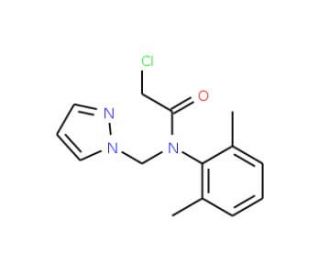

Metazachlor (CAS 67129-08-2)
QUICK LINKS
Metazachlor is a widely used herbicide used in agriculture and home gardens. It is a selective pre-emergence herbicide, meaning it is used to kill weeds before they sprout. Metazachlor is a chloroacetamide herbicide, and is chemically similar to acetochlor, which is used in the same way. Metazachlor is used to control annual grasses and broadleaf weeds in a variety of crops, including corn, soybeans, cotton, and sugar beets. It is also used to control weeds in turf, lawns, and home gardens. Metazachlor works by inhibiting the enzyme acetohydroxyacid synthase (AHAS), which is responsible for the synthesis of branched-chain amino acids. By blocking the enzyme, it prevents the formation of essential proteins, which are necessary for the growth of weeds. Metazachlor also inhibits weed growth by reducing chlorophyll in their leaves, decreasing photosynthesis, and hindering enzyme production essential for carbohydrate breakdown, thus limiting energy for growth. Researchers have been exploring the potential for Metazachlor to be used as an alternative to traditional herbicides, such as glyphosate, in order to reduce the environmental impact of herbicides.
Metazachlor (CAS 67129-08-2) References
- Environmental fate of herbicides trifluralin, metazachlor, metamitron and sulcotrione compared with that of glyphosate, a substitute broad spectrum herbicide for different glyphosate-resistant crops. | Mamy, L., et al. 2005. Pest Manag Sci. 61: 905-16. PMID: 16041722
- Response of plankton communities in freshwater pond and stream mesocosms to the herbicide metazachlor. | Mohr, S., et al. 2008. Environ Pollut. 152: 530-42. PMID: 17719156
- Herbicide effects of metazachlor on duckweed (Lemna minor and Spirodela polyrhiza) in test systems with different trophic status and complexity. | Müller, R., et al. 2010. J Environ Sci Health B. 45: 95-101. PMID: 20390937
- Assessment of the Environmental Fate of the Herbicides Flufenacet and Metazachlor with the SWAT Model. | Fohrer, N., et al. 2014. J Environ Qual. 43: 75-85. PMID: 25602542
- The functional role of the photosynthetic apparatus in the recovery of Brassica napus plants from pre-emergent metazachlor exposure. | Vercampt, H., et al. 2016. J Plant Physiol. 196-197: 99-105. PMID: 27135933
- Short-term phytotoxicity in Brassica napus (L.) in response to pre-emergently applied metazachlor: A microcosm study. | Vercampt, H., et al. 2017. Environ Toxicol Chem. 36: 59-70. PMID: 27345821
- Metazachlor traces in the main drinking water reservoir in Luxembourg: a scientific and political discussion. | Karier, P., et al. 2017. Environ Sci Eur. 29: 25. PMID: 28983450
- Hydrological tracers, the herbicide metazachlor and its transformation products in a retention pond during transient flow conditions. | Ulrich, U., et al. 2019. Environ Sci Pollut Res Int. 26: 26706-26720. PMID: 31297708
- Metazachlor: Mode of action analysis for rat liver tumour formation and human relevance. | Wiemann, C., et al. 2019. Toxicology. 426: 152282. PMID: 31465819
- Effects of metazachlor and its major metabolite metazachlor OA on early life stages of marbled crayfish. | Velisek, J., et al. 2020. Sci Rep. 10: 875. PMID: 31964976
- The difference in dissipation of clomazone and metazachlor in soil under field and laboratory conditions and their uptake by plants. | Szpyrka, E., et al. 2020. Sci Rep. 10: 3747. PMID: 32111959
- The effects of the herbicides terbuthylazine and metazachlor at environmental concentration on the burrowing behaviour of red swamp crayfish. | Guo, W., et al. 2021. Chemosphere. 270: 128656. PMID: 33172666
- Chloroacetanilides inhibit photosynthesis and disrupt the thylakoid membranes of the dinoflagellate Prorocentrum minimum as revealed with metazachlor treatment. | Kim, H., et al. 2021. Ecotoxicol Environ Saf. 211: 111928. PMID: 33476845
- Metazachlor effect on poplar - Pioneer plant species for riparian buffers. | Maršík, P., et al. 2021. Chemosphere. 274: 129711. PMID: 33524867
- Effects of the herbicides metazachlor and flufenacet on phytoplankton communities - A microcosm assay. | Wijewardene, L., et al. 2021. Ecotoxicol Environ Saf. 228: 113036. PMID: 34861440
Ordering Information
| Product Name | Catalog # | UNIT | Price | Qty | FAVORITES | |
Metazachlor, 100 mg | sc-235604 | 100 mg | $74.00 |