
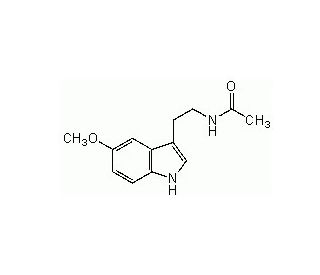

Melatonin (CAS 73-31-4)
See product citations (16)
QUICK LINKS
Melatonin is an indoleamine neurohormone found across plants and animals, produced endogenously from serotonin (5-HT) and secreted in animals as a regulatory signal for synchronization of the circadian rhythm and the sleep-wake cycle. The melatonin receptor system, consisting of the MEL-1A-R, MEL-1B-R, and MT3 subtypes, demonstrates particular plasticity and modularity - antagonists such as Luzindole (sc-202700) and 2-Phenylmelatonin (sc-203466) show modification of systemic responses to the Melatonin signal without impeding activation of the receptors by Melatonin. Powerful antioxidant activity is associated with Melatonin, and it is known to provide protection to lipids, proteins, and DNA against oxidative damage. Several antioxidant enzymes are shown to be upregulated by Melatonin, including glutathione peroxidase, superoxide dismutases, and catalase. Melatonin also scavenges free radicals as a terminal antioxidant, reacting to generate stable end products and terminate radical chain reactions. Free movement through the blood-brain barrier positions Melatonin as a particularly significant endogenous antioxidant. Melatonin is a rat NOS1 (nNOS) inhibitor. Melatonin is an activator of MEL-1A-R and MEL-1B-R.
Melatonin (CAS 73-31-4) References
- Free radical-mediated molecular damage. Mechanisms for the protective actions of melatonin in the central nervous system. | Reiter, RJ., et al. 2001. Ann N Y Acad Sci. 939: 200-15. PMID: 11462772
- Molecular tools to study melatonin pathways and actions. | Boutin, JA., et al. 2005. Trends Pharmacol Sci. 26: 412-9. PMID: 15992934
- Antioxidative protection by melatonin: multiplicity of mechanisms from radical detoxification to radical avoidance. | Hardeland, R. 2005. Endocrine. 27: 119-30. PMID: 16217125
- Pharmacology and function of melatonin receptors. | Dubocovich, ML. 1988. FASEB J. 2: 2765-73. PMID: 2842214
- Melatonin Inhibits in Vitro Smooth Muscle Cell Inflammation and Proliferation and Atherosclerosis in Apolipoprotein E-Deficient Mice. | Li, HY., et al. 2019. J Agric Food Chem. 67: 1889-1901. PMID: 30661353
- Melatonin synergizes BRAF-targeting agent vemurafenib in melanoma treatment by inhibiting iNOS/hTERT signaling and cancer-stem cell traits. | Hao, J., et al. 2019. J Exp Clin Cancer Res. 38: 48. PMID: 30717768
- Melatonin stabilizes rupture-prone vulnerable plaques via regulating macrophage polarization in a nuclear circadian receptor RORα-dependent manner. | Ding, S., et al. 2019. J Pineal Res. 67: e12581. PMID: 31009101
- Melatonin Suppresses Ferroptosis Induced by High Glucose via Activation of the Nrf2/HO-1 Signaling Pathway in Type 2 Diabetic Osteoporosis. | Ma, H., et al. 2020. Oxid Med Cell Longev. 2020: 9067610. PMID: 33343809
- Melatonin Attenuates Neuroinflammation by Down-Regulating NLRP3 Inflammasome via a SIRT1-Dependent Pathway in MPTP-Induced Models of Parkinson's Disease. | Zheng, R., et al. 2021. J Inflamm Res. 14: 3063-3075. PMID: 34267535
- Melatonin-mediated FKBP4 downregulation protects against stress-induced neuronal mitochondria dysfunctions by blocking nuclear translocation of GR. | Kim, MJ., et al. 2023. Cell Death Dis. 14: 146. PMID: 36810730
- Psychopharmacological effects of melatonin in mouse and rat. | Sugden, D. 1983. J Pharmacol Exp Ther. 227: 587-91. PMID: 6655558
- Melatonin receptors: are there multiple subtypes? | Dubocovich, ML. 1995. Trends Pharmacol Sci. 16: 50-6. PMID: 7762083
- Identification of melatonin in plants and its effects on plasma melatonin levels and binding to melatonin receptors in vertebrates. | Hattori, A., et al. 1995. Biochem Mol Biol Int. 35: 627-34. PMID: 7773197
- Selective MT2 melatonin receptor antagonists block melatonin-mediated phase advances of circadian rhythms. | Dubocovich, ML., et al. 1998. FASEB J. 12: 1211-20. PMID: 9737724
Ordering Information
| Product Name | Catalog # | UNIT | Price | Qty | FAVORITES | |
Melatonin, 1 g | sc-207848 | 1 g | $65.00 | |||
Melatonin, 5 g | sc-207848A | 5 g | $73.00 | |||
Melatonin, 25 g | sc-207848B | 25 g | $218.00 | |||
Melatonin, 100 g | sc-207848C | 100 g | $697.00 | |||
Melatonin, 250 g | sc-207848D | 250 g | $1196.00 | |||
Melatonin, 1 kg | sc-207848E | 1 kg | $3574.00 |