
matrin-3 CRISPR/Cas9 KO Plasmid (h): sc-418085
- Target species: human
- 20 µg of transfection-ready, purified plasmid DNA; Suitable for up to 20 transfections
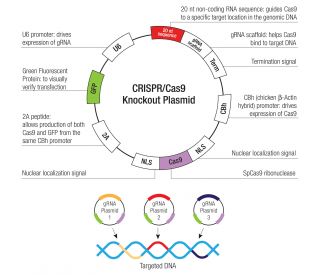
- matrin-3 CRISPR/Cas9 Knockout (KO) Plasmid (h) is a pool of plasmids, each encoding Cas9 nuclease and a target-specific 20 nt guide RNA (gRNA) designed for maximum knockout efficiency using sequences derived from the GeCKO v2 library
- gRNA sequences direct Cas9 to induce site-specific double-strand breaks (DSBs) in the matrin-3 genomic locus, resulting in gene knockout through non-homologous end joining (NHEJ)
- The puromycin resistance and RFP genes are flanked by LoxP sites, enabling removal of selection markers via Cre recombinase (Cre Vector: sc-418923) after establishing stable knockout cell lines
- Following transfection, gene knockout efficiency can be assayed by WB, IF or IHC using antibody: matrin-3 Antibody (2539C3a): sc-81318

Ordering Information
| Product Name | Catalog # | UNIT | Price | Qty | FAVORITES | |
matrin-3 CRISPR/Cas9 KO Plasmid (h) | sc-418085 | 20 µg | $397.00 |
Overview
MATR3 encodes matrin-3, a nuclear matrix RNA/DNA-binding protein that associates with the nuclear lamina and chromatin to support nuclear architecture and genome organization. Matrin-3 participates in RNA processing, including pre-mRNA splicing, mRNA stabilization, and regulation of gene expression through interactions with ribonucleoprotein complexes. Its functions intersect with pathways governing nucleocytoplasmic organization, DNA damage responses, and stress granule dynamics, linking MATR3 to proteostasis and RNA homeostasis in neurons. Dysregulation or mutation of MATR3 has been associated with neurodegenerative phenotypes, including ALS/FTD spectrum disorders, making it relevant for studies of RNA-binding protein dysfunction and nuclear structural defects.
matrin-3 CRISPR/Cas9 KO Plasmid (h) is a pool of plasmids designed for targeted disruption of the MATR3 gene in human cell lines. Each plasmid co-expresses a unique single guide RNA (sgRNA) targeting a distinct site within the MATR3 together with the Streptococcus pyogenes Cas9 nuclease. The plasmids also encode GFP, allowing fluorescent identification and enrichment of successfully transfected cells by fluorescence microscopy or flow cytometry.
The multi-guide design increases the likelihood of generating insertions or deletions (indels) that disrupt the MATR3 open reading frame following Cas9-mediated double-strand break formation. DNA breaks introduced by the CRISPR/Cas9 system are repaired through endogenous non-homologous end joining (NHEJ) pathways, frequently resulting in frameshift mutations that abolish matrin-3 protein expression.
This CRISPR knockout system enables efficient generation of MATR3-deficient cell models for investigation of matrin-3 signaling, functional genomics studies, cancer biology research, and evaluation of therapeutic responses in human cell lines.
Key Features
- sgRNAs targeting MATR3 exon(s) critical for matrin-3 function
- Co-expression of SpCas9 and sgRNA from a single plasmid for simplified delivery
- GFP reporter for identification of transfected cells
- Pool of plasmids targeting multiple MATR3 genomic sites to improve knockout efficiency
- Compatible with delivery by transfection
Design Variants
CRISPRs +/- HDRs
- gRNAs encoded by matrin-3 CRISPR/Cas9 KO Plasmid (h) and matrin-3 CRISPR/Cas9 KO Plasmid (h2) target distinct sites within the MATR3 locus. One or both targeting designs may be available. See Related Products for availability.
- HDR donor constructs encoded by matrin-3 HDR Plasmid (h) and matrin-3 HDR Plasmid (h2) contain a puromycin resistance cassette and an RFP reporter flanked by MATR3 homology arms to support homology-directed repair at defined MATR3 target sites corresponding to the CRISPR/Cas9 KO designs. HDR donor availability may vary. See Related Products for availability.
For Research Use Only. Not Intended for Diagnostic or Therapeutic Use.