
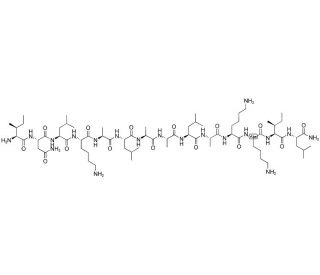

Mastoparan (CAS 72093-21-1)
QUICK LINKS
Mastoparan (Vespula lewisii) may act to cause an increase in the production of Arachidonic Acid (sc-200770) catalyzed by PLA2 from porcine pancreas and bee venom. This compound also displays toxicity by regulating G proteins via mimicking of G-protein-coupled receptors. Additionally, Mastoparan has been reported as a stimulator of insulin release by pancreatic islets, which acts through GTP-binding proteins and PLA2. In other experiments, this agent has demonstrated the ability to cause exocytosis of rat peritoneal mast cells and also stimulate the accumulation of inositol phosphates in hepatocytes. In addition, Mastoparan has been noted to act as a mitogen in Swiss 3T3 cells and stimulate pertussis toxin-sensitive Arachidonate release without phosphoinositide breakdown. Mastoparan is an inhibitor of CaM and an activator of Heterotrimeric G Protein and PLA2.
Mastoparan (CAS 72093-21-1) References
- Mastoparan induces Ca2+-independent cortical granule exocytosis in sea urchin eggs. | López-Godínez, J., et al. 2003. Biochem Biophys Res Commun. 301: 13-6. PMID: 12535633
- Mastoparan, a novel mitogen for Swiss 3T3 cells, stimulates pertussis toxin-sensitive arachidonic acid release without inositol phosphate accumulation. | Gil, J., et al. 1991. J Cell Biol. 113: 943-50. PMID: 1709171
- Mastoparan-induced hormone release from rat pancreatic islets. | Komatsu, M., et al. 1992. Endocrinology. 130: 221-8. PMID: 1727698
- Regulation of Gi and Go by mastoparan, related amphiphilic peptides, and hydrophobic amines. Mechanism and structural determinants of activity. | Higashijima, T., et al. 1990. J Biol Chem. 265: 14176-86. PMID: 2117607
- Activation of rat peritoneal mast cells by substance P and mastoparan. | Mousli, M., et al. 1989. J Pharmacol Exp Ther. 250: 329-35. PMID: 2473189
- Mastoparan, a wasp venom, stimulates insulin release by pancreatic islets through pertussis toxin sensitive GTP-binding protein. | Yokokawa, N., et al. 1989. Biochem Biophys Res Commun. 158: 712-6. PMID: 2493246
- Mastoparan induces apoptosis in B16F10-Nex2 melanoma cells via the intrinsic mitochondrial pathway and displays antitumor activity in vivo. | de Azevedo, RA., et al. 2015. Peptides. 68: 113-9. PMID: 25305549
- Three valuable peptides from bee and wasp venoms for therapeutic and biotechnological use: melittin, apamin and mastoparan. | Moreno, M. and Giralt, E. 2015. Toxins (Basel). 7: 1126-50. PMID: 25835385
- Mastoparan is a membranolytic anti-cancer peptide that works synergistically with gemcitabine in a mouse model of mammary carcinoma. | Hilchie, AL., et al. 2016. Biochim Biophys Acta. 1858: 3195-3204. PMID: 27693190
- Mastoparan, a peptide toxin from wasp venom, mimics receptors by activating GTP-binding regulatory proteins (G proteins). | Higashijima, T., et al. 1988. J Biol Chem. 263: 6491-4. PMID: 3129426
- Nuclear magnetic resonance studies on conformation and stability of mastoparan in methanol. | Miura, Y. 2021. J Pept Sci. 27: e3338. PMID: 33973297
- In Silico and In Vitro Structure-Activity Relationship of Mastoparan and Its Analogs. | Rungsa, P., et al. 2022. Molecules. 27: PMID: 35056876
- Facilitation of phospholipase A2 activity by mastoparans, a new class of mast cell degranulating peptides from wasp venom. | Argiolas, A. and Pisano, JJ. 1983. J Biol Chem. 258: 13697-702. PMID: 6643447
Ordering Information
| Product Name | Catalog # | UNIT | Price | Qty | FAVORITES | |
Mastoparan, 1 mg | sc-200831 | 1 mg | $99.00 |