
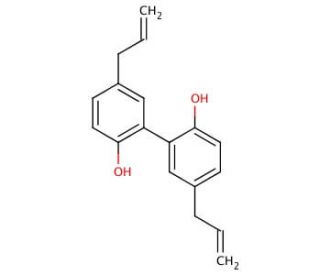

Magnolol (CAS 528-43-8)
See product citations (1)
QUICK LINKS
Magnolol is a natural compound extracted primarily from the bark of the Magnolia officinalis tree. It is classified as a lignan, a type of phenolic compound known for its potent bioactivity. The chemical structure of magnolol allows it to interact with a variety of molecular targets, primarily influencing signaling pathways that regulate inflammation and oxidative stress. One significant mechanism of action of magnolol involves its ability to modulate the activity of transcription factors such as NF-κB (nuclear factor kappa-light-chain-enhancer of activated B cells), which plays a critical role in the inflammatory response. By inhibiting NF-κB activation, magnolol can reduce the expression of pro-inflammatory cytokines and mediators, thereby modulating inflammatory processes. Additionally, magnolol exhibits antioxidant properties by scavenging free radicals and enhancing the activity of antioxidant enzymes, which protects cells from oxidative damage. In research, magnolol has been used to study its effects on cellular mechanisms in models of inflammation, oxidative stress, and apoptosis. Its impact on these fundamental cellular processes makes it an interesting subject for investigations into how natural compounds can influence cellular health and stability. Moreover, magnolol′s interactions with cellular signaling pathways provide valuable insights into the potential mechanisms by which natural products can affect cellular function and homeostasis.
Magnolol (CAS 528-43-8) References
- Inhibitors of nitric oxide synthesis and TNF-alpha expression from Magnolia obovata in activated macrophages. | Son, HJ., et al. 2000. Planta Med. 66: 469-71. PMID: 10909270
- Down-modulation of Bcl-XL, release of cytochrome c and sequential activation of caspases during honokiol-induced apoptosis in human squamous lung cancer CH27 cells. | Yang, SE., et al. 2002. Biochem Pharmacol. 63: 1641-51. PMID: 12007567
- Honokiol, a small molecular weight natural product, inhibits angiogenesis in vitro and tumor growth in vivo. | Bai, X., et al. 2003. J Biol Chem. 278: 35501-7. PMID: 12816951
- Inhibitory effect of magnolol on tumour metastasis in mice. | Ikeda, K., et al. 2003. Phytother Res. 17: 933-7. PMID: 13680828
- Honokiol potentiates apoptosis, suppresses osteoclastogenesis, and inhibits invasion through modulation of nuclear factor-kappaB activation pathway. | Ahn, KS., et al. 2006. Mol Cancer Res. 4: 621-33. PMID: 16966432
- Magnolol and honokiol: inhibitors against mouse passive cutaneous anaphylaxis reaction and scratching behaviors. | Han, SJ., et al. 2007. Biol Pharm Bull. 30: 2201-3. PMID: 17978501
- Anti-inflammatory effect of honokiol is mediated by PI3K/Akt pathway suppression. | Kim, BH. and Cho, JY. 2008. Acta Pharmacol Sin. 29: 113-22. PMID: 18158873
- Honokiol is a potent scavenger of superoxide and peroxyl radicals. | Dikalov, S., et al. 2008. Biochem Pharmacol. 76: 589-96. PMID: 18640101
- Honokiol and magnolol as multifunctional antioxidative molecules for dermatologic disorders. | Shen, JL., et al. 2010. Molecules. 15: 6452-65. PMID: 20877235
- Transcriptional and functional analysis of the effects of magnolol: inhibition of autolysis and biofilms in Staphylococcus aureus. | Wang, D., et al. 2011. PLoS One. 6: e26833. PMID: 22046374
- Wnt/β-catenin signaling mediates the antitumor activity of magnolol in colorectal cancer cells. | Kang, YJ., et al. 2012. Mol Pharmacol. 82: 168-77. PMID: 22550094
- Potent and selective inhibition of magnolol on catalytic activities of UGT1A7 and 1A9. | Zhu, L., et al. 2012. Xenobiotica. 42: 1001-8. PMID: 22591254
- Suppression of PKCΔ/NF-κB Signaling and Apoptosis Induction through Extrinsic/Intrinsic Pathways Are Associated Magnolol-Inhibited Tumor Progression in Colorectal Cancer In Vitro and In Vivo. | Su, CM., et al. 2020. Int J Mol Sci. 21: PMID: 32429376
- Pharmacological properties of magnolol and honokiol extracted from Magnolia officinalis: central depressant effects. | Watanabe, K., et al. 1983. Planta Med. 49: 103-8. PMID: 6657781
- Identification of magnolol and honokiol as anxiolytic agents in extracts of saiboku-to, an oriental herbal medicine. | Maruyama, Y., et al. 1998. J Nat Prod. 61: 135-8. PMID: 9461663
Ordering Information
| Product Name | Catalog # | UNIT | Price | Qty | FAVORITES | |
Magnolol, 5 mg | sc-204797 | 5 mg | $43.00 | |||
Magnolol, 25 mg | sc-204797A | 25 mg | $189.00 |