
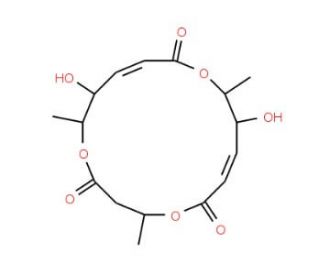

Macrosphelide A (CAS 172923-77-2)
QUICK LINKS
Macrosphelide A, a natural product derived from marine sources, has emerged as a significant subject of scientific research due to its intriguing chemical structure and potential biological activities. This compound exhibits diverse biological properties, including cytotoxicity, antimicrobial activity, and inhibition of protein-protein interactions. Researchers have been particularly interested in Macrosphelide A′s mechanism of action and its potential applications in drug discovery and chemical biology. Studies have focused on elucidating the molecular targets and pathways affected by Macrosphelide A, such as its interaction with specific protein targets involved in cellular signaling or metabolic processes. Additionally, its cytotoxic effects have led to investigations into its potential as an anticancer agent, with studies exploring its impact on cancer cell proliferation, apoptosis, and metastasis. Furthermore, Macrosphelide A′s antimicrobial activity has been investigated for its potential in combating drug-resistant bacterial strains and fungal pathogens. Moreover, its ability to modulate protein-protein interactions has sparked interest in its role as a chemical probe for studying protein function and cellular pathways implicated in various diseases. Beyond its biological activities, Macrosphelide A has found applications in chemical synthesis and structural biology, serving as a scaffold for the design and development of novel bioactive compounds and as a tool for elucidating the structure-activity relationships of natural products. With its versatile properties and potential biomedical applications, Macrosphelide A continues to be a focus of scientific inquiry in multiple research fields.
Macrosphelide A (CAS 172923-77-2) References
- Production of macrosphelide A by the mycoparasite Coniothyrium minitans. | McQuilken, MP., et al. 2003. FEMS Microbiol Lett. 219: 27-31. PMID: 12594019
- Diphenylether and macrotriolides occurring in a fungal isolate from the antarctic lichen Neuropogon. | Ivanova, V., et al. 2007. Prep Biochem Biotechnol. 37: 39-45. PMID: 17134981
- Antimicrobial activity of Coniothyrium minitans and its macrolide antibiotic macrosphelide A. | Tomprefa, N., et al. 2009. J Appl Microbiol. 106: 2048-56. PMID: 19298513
- Macrosphelide A Exhibits a Specific Anti-Cancer Effect by Simultaneously Inactivating ENO1, ALDOA, and FH. | Song, K., et al. 2021. Pharmaceuticals (Basel). 14: PMID: 34681284
- Macrosphelides from Antarctic fungus Pseudogymnoascus sp. (strain SF-7351) and their neuroprotective effects on BV2 and HT22 cells. | Liu, Z., et al. 2023. Chem Biol Interact. 385: 110718. PMID: 37777167
- Botrytis cinerea type II inhibitor of apoptosis BcBIR1 enhances the biocontrol capacity of Coniothyrium minitans. | Wu, J., et al. 2024. Microb Biotechnol. 17: e14402. PMID: 38393322
- Macrosphelide, a novel inhibitor of cell-cell adhesion molecule. I. Taxonomy, fermentation, isolation and biological activities. | Hayashi, M., et al. 1995. J Antibiot (Tokyo). 48: 1435-9. PMID: 8557600
- Macrosphelide, a novel inhibitor of cell-cell adhesion molecule. II. Physiochemical properties and structural elucidation. | Takamatsu, S., et al. 1996. J Antibiot (Tokyo). 49: 95-8. PMID: 8609095
- Some environmental factors affect growth and antibiotic production by the mycoparasite Coniothyrium minitans | Tomprefa, N., et al. 2011. Biocontrol science and technology. 21(6): 721-731.
Ordering Information
| Product Name | Catalog # | UNIT | Price | Qty | FAVORITES | |
Macrosphelide A, 1 mg | sc-280949 | 1 mg | $98.00 | |||
Macrosphelide A, 5 mg | sc-280949A | 5 mg | $390.00 |