
Date published: 2026-5-17

1-800-457-3801

SCBT Portrait Logo
Seach Input

Macrophage Marker Antibody (25F9): sc-52698

4.0(1)
Write a reviewAsk a question

Datasheets
  • Macrophage Marker Antibody (25F9) is a mouse monoclonal IgG1 provided at 100 µg/ml
  • recommended for detection of mature macrophages of human and porcine origin by WB, IF, IHC(P) and FCM
  • See Macrophage Marker (MAC387): sc-66204 for Macrophage Marker antibody conjugates, including AC, HRP, FITC, PE, Alexa Fluor® 488, 594, 647, 680 and 790.
  • At present, we have not yet completed the identification of the preferred secondary detection reagent(s) for Macrophage Marker Antibody (25F9). This work is in progress.

    Gene Editing Promo Banner

    QUICK LINKS

    SEE ALSO...

    Macrophage Marker Antibody (25F9) is a mouse monoclonal IgG1 antibody that detects Macrophage Marker in human and porcine samples through various applications including western blotting (WB), immunofluorescence (IF), immunohistochemistry with paraffin-embedded sections (IHCP), and flow cytometry (FCM). Macrophage Marker (25F9) antibody plays a crucial role in identifying macrophages, which are essential components of the immune system, responsible for phagocytosing pathogens and debris, thus maintaining tissue homeostasis. These cells are strategically located in tissues throughout the body, where they can quickly respond to infection or injury. The presence of macrophages in tissues allows for immediate immune responses, as they can recognize and eliminate pathogens without the need for prior sensitization. This rapid response is vital for controlling infections and initiating the healing process, highlighting the importance of Macrophage Marker in both research and clinical settings. Anti-Macrophage Marker antibody (25F9) enables researchers to effectively study macrophage behavior, differentiation, and their interactions with other immune cells, providing insights into various diseases and potential therapeutic targets.

    For Research Use Only. Not Intended for Diagnostic or Therapeutic Use.

    Alexa Fluor® is a trademark of Molecular Probes Inc., OR., USA

    LI-COR® and Odyssey® are registered trademarks of LI-COR Biosciences

    Macrophage Marker Antibody (25F9) References:

    1. LRP5: A novel anti-inflammatory macrophage marker that positively regulates migration and phagocytosis.  |  Ma, Y. 2016. J Mol Cell Cardiol. 91: 61-2. PMID: 26739212
    2. F4/80 as a Major Macrophage Marker: The Case of the Peritoneum and Spleen.  |  Dos Anjos Cassado, A. 2017. Results Probl Cell Differ. 62: 161-179. PMID: 28455709
    3. The macrophage marker translocator protein (TSPO) is down-regulated on pro-inflammatory 'M1' human macrophages.  |  Narayan, N., et al. 2017. PLoS One. 12: e0185767. PMID: 28968465
    4. The M2 macrophage marker CD206: a novel prognostic indicator for acute myeloid leukemia.  |  Xu, ZJ., et al. 2020. Oncoimmunology. 9: 1683347. PMID: 32002295
    5. Vestibular Schwannoma Volume and Tumor Growth Correlates with Macrophage Marker Expression.  |  Leisz, S., et al. 2022. Cancers (Basel). 14: PMID: 36139588
    6. Validating a Macrophage Marker Gene Signature (MMGS) in Lung Adenocarcinoma Prognosis and Response to Immunotherapy.  |  Song, P., et al. J Immunother. 46: 205-215. PMID: 37220007
    7. Identification and validation of a novel signature based on macrophage marker genes for predicting prognosis and drug response in kidney renal clear cell carcinoma by integrated analysis of single cell and bulk RNA sequencing.  |  Chen, X., et al. 2024. Aging (Albany NY). 16: 5676-5702. PMID: 38517387
    8. SFRP1 decreases WNT-Mediated M2 macrophage marker expression in breast tissue.  |  Gregory, KJ., et al. 2024. Cancer Immunol Immunother. 73: 86. PMID: 38554160
    9. Bioinformatics Analysis Reveals Prognostic Significance of the Macrophage Marker Gene Signature in Gastric Adenocarcinoma.  |  Li, Z., et al. 2024. Front Biosci (Landmark Ed). 29: 172. PMID: 38812299
    10. Identification of a Macrophage marker gene signature to evaluate immune infiltration and therapeutic response in hepatocellular carcinoma.  |  Li, T., et al. 2024. Heliyon. 10: e31881. PMID: 38845876

    Ordering Information

    Product NameCatalog #UNITPriceQtyFAVORITES

    Macrophage Marker Antibody (25F9)

    sc-52698
    100 µg/ml
    $322.00

    Macrophage maker antibody 25F9 is described as a "marker for mature macrophages" made against a cell lysate. This is a monoclonal antibody with a discrete antigen. Does it detect a specific protein? If so, what is it?

    Asked by: PaulS
    Thank you for your question. It would be helpful if you could call us, allowing for a more interactive discussion of this and other related questions.
    Answered by: Technical Support
    Date published: 2021-07-22

    is this offered biotinylated?

    Asked by: sallie
    Thank you for your question. It would be helpful if you could call us, allowing for a more interactive discussion of this and other related questions.
    Answered by: Technical Support
    Date published: 2021-07-22

    Could you please help me out in deciding that i can use this antibody to detect macrophage marker 25F9 on bovine macrophages, as this is a monoclonal antibody from human origin. Thus, if you could please let me know its cross reactivity.

    Asked by: Vivek30
    Thank you for your question. Macrophage Marker Antibody (25F9): sc-52698 is only recommended for detection of mature macrophages of human and porcine origin by WB, IF, IHC(P) and FCM. We do not have any data indicating cross-reactivity with bovine samples.
    Answered by: Technical Support Europe
    Date published: 2020-10-21

    Does this ab distinguish between suspension U937 cells and U937s differentiated into macrophages?

    Asked by: Ms Lisa
    Thank you for your question. We are not aware of any publications citing use of our Macrophage Marker Antibody (25F9): sc-52698 in U-937 cells for this purpose so we can not answer this question. The 25F9 clone recognizes a protein of 86 kDa on the cell surface and within the cytoplasm of mature macrophages. The antibody is associated with fully differentiated tissue macrophages both in normal and in diseased tissues, independently of the presence or absence of inflammation. The antigen is absent on freshly isolated monocytes and other blood cells.
    Answered by: Technical Support
    Date published: 2017-03-17

    How can Macrophage Marker (25F9): sc-52698 mouse monoclonal antibody be used for double or triple staining, if the other primary antibodies are also raised in mouse?

    Asked by: AbPolly
    In this case, we recommend using a directly conjugated mouse monoclonal primary antibody. This antibody is available conjugated to phycoerythrin (sc-52698 PE) or fluoroscein (sc-52698 FITC).
    Answered by: Technical Support
    Date published: 2017-02-25
    • y_2026, m_5, d_16, h_14CST
    • bvseo_bulk, prod_bvqa, vn_bulk_3.0.43
    • cp_1, bvpage1
    • co_hasquestionsanswers, tq_5
    • loc_en_US, sid_52698, prod, sort_[SortEntry(order=LAST_APPROVED_ANSWER_SUBMISSION_TIME, direction=DESCENDING)]
    • clientName_scbt
    • bvseo_sdk, java_sdk, bvseo-4.0.0
    • CLOUD, getContent, 101ms
    • QUESTIONS, PRODUCT
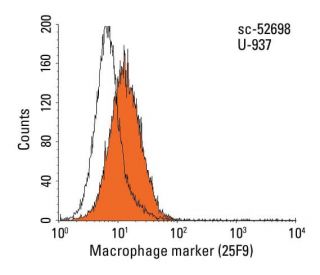
    Rated 4 out of 5 by from Good indirect FCM analysis of UGood indirect FCM analysis of U-937 cells stained with Macrophage marker . -SCBT QC
    Date published: 2013-09-19
    • y_2026, m_5, d_15, h_13
    • bvseo_bulk, prod_bvrr, vn_bulk_3.0.43
    • cp_1, bvpage1
    • co_hasreviews, tv_0, tr_1
    • loc_en_US, sid_52698, prod, sort_[SortEntry(order=SUBMISSION_TIME, direction=DESCENDING)]
    • clientName_scbt
    • bvseo_sdk, java_sdk, bvseo-4.0.0
    • CLOUD, getReviews, 7ms
    • REVIEWS, PRODUCT
    Macrophage Marker Antibody (25F9) is rated 4.0 out of 5 by 1.
    • y_2026, m_5, d_15, h_13
    • bvseo_bulk, prod_bvrr, vn_bulk_3.0.43
    • cp_1, bvpage1
    • co_hasreviews, tv_0, tr_1
    • loc_en_US, sid_52698, prod, sort_[SortEntry(order=SUBMISSION_TIME, direction=DESCENDING)]
    • clientName_scbt
    • bvseo_sdk, java_sdk, bvseo-4.0.0
    • CLOUD, getAggregateRating, 95ms
    • REVIEWS, PRODUCT