
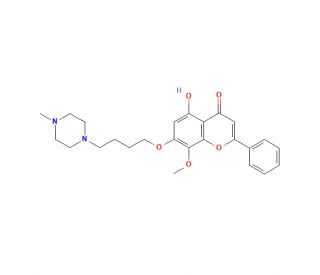

LYG-202 (CAS 1175077-25-4)
QUICK LINKS
LYG-202 is a notable compound recognized for its potent ability to inhibit the function of bromodomain-containing protein 4 (BRD4), a member of the BET protein family that plays a role in regulating gene expression by modifying the structure of chromatin. The mechanism of action of LYG-202 centers around its high affinity for the acetylated lysine recognition motifs on BRD4, which allows it to effectively displace the protein from chromatin, leading to altered expression patterns of genes involved in cell proliferation and survival. This characteristic makes LYG-202 useful in research focused on understanding the epigenetic regulation of gene expression and its implications in cellular function and pathology. Studies employing LYG-202 can provide insights into the dynamic interactions within the chromatin landscape and help elucidate the complex networks of gene regulation that can be manipulated for applications in various research fields, including oncology and beyond.
LYG-202 (CAS 1175077-25-4) References
- LYG-202, a new flavonoid with a piperazine substitution, shows antitumor effects in vivo and in vitro. | Zeng, S., et al. 2009. Biochem Biophys Res Commun. 385: 551-6. PMID: 19481059
- LYG-202, a newly synthesized flavonoid, exhibits potent anti-angiogenic activity in vitro and in vivo. | Chen, Y., et al. 2010. J Pharmacol Sci. 112: 37-45. PMID: 20093787
- Reactive oxygen species-mitochondria pathway involved in LYG-202-induced apoptosis in human hepatocellular carcinoma HepG(2) cells. | Chen, FH., et al. 2010. Cancer Lett. 296: 96-105. PMID: 20580989
- LYG-202 inhibits the proliferation of human colorectal carcinoma HCT-116 cells through induction of G1/S cell cycle arrest and apoptosis via p53 and p21(WAF1/Cip1) expression. | Liu, W., et al. 2011. Biochem Cell Biol. 89: 287-98. PMID: 21491996
- LYG-202 augments tumor necrosis factor-α-induced apoptosis via attenuating casein kinase 2-dependent nuclear factor-κB pathway in HepG2 cells. | Chen, FH., et al. 2012. Mol Pharmacol. 82: 958-71. PMID: 22909797
- LZ-207, a Newly Synthesized Flavonoid, Induces Apoptosis and Suppresses Inflammation-Related Colon Cancer by Inhibiting the NF-κB Signaling Pathway. | Sun, J., et al. 2015. PLoS One. 10: e0127282. PMID: 26023926
- LYG-202 exerts antitumor effect on PI3K/Akt signaling pathway in human breast cancer cells. | Zhao, Y., et al. 2015. Apoptosis. 20: 1253-69. PMID: 26153346
- Activation of endoplasmic reticulum stress and the extrinsic apoptotic pathway in human lung cancer cells by the new synthetic flavonoid, LZ-205. | Zhang, Y., et al. 2016. Oncotarget. 7: 87257-87270. PMID: 27895312
- LYG-202 inhibits activation of endothelial cells and angiogenesis through CXCL12/CXCR7 pathway in breast cancer. | Zhao, K., et al. 2018. Carcinogenesis. 39: 588-600. PMID: 29390073
- Decursin inhibits tumor growth, migration, and invasion in gastric cancer by down-regulating CXCR7 expression. | Kim, S., et al. 2019. Am J Cancer Res. 9: 2007-2018. PMID: 31598401
- Antiangiogenic Activity of Flavonoids: A Systematic Review and Meta-Analysis. | Khater, M., et al. 2020. Molecules. 25: PMID: 33066630
- ALDOA maintains NLRP3 inflammasome activation by controlling AMPK activation. | Bai, D., et al. 2022. Autophagy. 18: 1673-1693. PMID: 34821530
- The inhibitory effect and mechanism of Resina Draconis on the proliferation of MCF-7 breast cancer cells: a network pharmacology-based analysis. | Lv, Y., et al. 2023. Sci Rep. 13: 3816. PMID: 36882618
Ordering Information
| Product Name | Catalog # | UNIT | Price | Qty | FAVORITES | |
LYG-202, 5 mg | sc-396595 | 5 mg | $208.00 | |||
LYG-202, 10 mg | sc-396595A | 10 mg | $408.00 |