
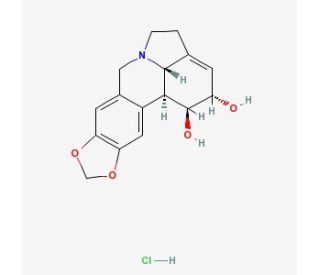

Lycorine hydrochloride (CAS 2188-68-3)
QUICK LINKS
Lycorine hydrochloride is a chemical compound known for its role in biological research, particularly in the study of cellular processes. In research environments, it is often used to investigate the mechanisms of action in inhibiting protein synthesis within cells, which has implications for understanding the regulation of cell growth. Additionally, lycorine hydrochloride has been utilized in studies focused on apoptosis, the programmed cell death for maintaining cellular health and balance. Researchers have also explored its impact on different enzymes and metabolic pathways within organisms. The chemical′s ability to bind to certain cellular structures and influence their function makes it useful in the field of molecular biology, where it aids in elucidating complex biochemical pathways.
Lycorine hydrochloride (CAS 2188-68-3) References
- Lycorine hydrochloride inhibits metastatic melanoma cell-dominant vasculogenic mimicry. | Liu, R., et al. 2012. Pigment Cell Melanoma Res. 25: 630-8. PMID: 22781316
- Lycorine hydrochloride selectively inhibits human ovarian cancer cell proliferation and tumor neovascularization with very low toxicity. | Cao, Z., et al. 2013. Toxicol Lett. 218: 174-85. PMID: 23376478
- Anti-dengue-virus activity and structure-activity relationship studies of lycorine derivatives. | Wang, P., et al. 2014. ChemMedChem. 9: 1522-33. PMID: 24574246
- Study on apoptosis effect of human breast cancer cell MCF-7 induced by lycorine hydrochloride via death receptor pathway. | Ji, Y., et al. 2017. Saudi Pharm J. 25: 633-637. PMID: 28579903
- Lycorine: a eukaryotic termination inhibitor? | Vrijsen, R., et al. 1986. J Biol Chem. 261: 505-7. PMID: 3001065
- Lycorine Hydrochloride Inhibits the Virulence Traits of Candida albicans. | Yang, L., et al. 2019. Biomed Res Int. 2019: 1851740. PMID: 31275963
- Lycorine hydrochloride inhibits cell proliferation and induces apoptosis through promoting FBXW7-MCL1 axis in gastric cancer. | Li, C., et al. 2020. J Exp Clin Cancer Res. 39: 230. PMID: 33126914
- Lycorine hydrochloride induces reactive oxygen species-mediated apoptosis via the mitochondrial apoptotic pathway and the JNK signaling pathway in the oral squamous cell carcinoma HSC-3 cell line. | Li, MH., et al. 2021. Oncol Lett. 21: 236. PMID: 33613725
- Identification of natural compounds tubercidin and lycorine HCl against small-cell lung cancer and BCAT1 as a therapeutic target. | Chen, J., et al. 2022. J Cell Mol Med. 26: 2557-2565. PMID: 35318805
- Lycorine and organ protection: Review of its potential effects and molecular mechanisms. | Xiao, H., et al. 2022. Phytomedicine. 104: 154266. PMID: 35752077
- Peptidyltransferase center of ribosomes. On the mechanism of action of alkaloid lycorine. | Kukhanova, M., et al. 1983. FEBS Lett. 160: 129-33. PMID: 6350039
- [Hypotensive effect of dihydrolycorine]. | Chen, BY., et al. 1993. Zhongguo Yao Li Xue Bao. 14: 45-9. PMID: 8503287
- The inhibitory effect of lycorine on tumor cell apoptosis induced by polymorphonuclear leukocyte-derived calprotectin. | Yui, S., et al. 1998. Immunopharmacology. 40: 151-62. PMID: 9826029
Ordering Information
| Product Name | Catalog # | UNIT | Price | Qty | FAVORITES | |
Lycorine hydrochloride, 10 mg | sc-200917 | 10 mg | $84.00 | |||
Lycorine hydrochloride, 50 mg | sc-200917A | 50 mg | $316.00 |