
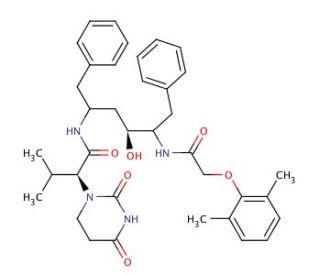

Lopinavir Metabolite M-1 (CAS 192725-39-6)
QUICK LINKS
Lopinavir Metabolite M-1 is a primary oxidative metabolite of lopinavir, and it plays a crucial role in scientific research, particularly for understanding the biochemical and metabolic processes involving lopinavir. This metabolite helps explain the pharmacokinetics and metabolic pathways of its parent compound, particularly how it is processed and transformed within the body. Lopinavir Metabolite M-1 is produced through the action of cytochrome P450 enzymes, primarily CYP3A, which are responsible for the oxidative metabolism of many compounds in the liver. The formation of M-1 from lopinavir involves the hydroxylation of the parent molecule, which is a key step in understanding the compound′s biotransformation. This process is critical for studying how substances are metabolized and eventually excreted from the body. In research settings, Lopinavir Metabolite M-1 is used to investigate the metabolic pathways and mechanisms of lopinavir. By analyzing this metabolite, researchers can gain insights into the absorption, distribution, metabolism, and excretion (ADME) of lopinavir. Such studies are essential for understanding the metabolic profile and for identifying factors that might influence the metabolism of the parent compound. Lopinavir Metabolite M-1 also serves as a marker in bioanalytical studies to measure the metabolic activity of lopinavir. Quantifying this metabolite in biological samples helps assess the rate at which lopinavir is metabolized. This is important for understanding the efficiency of metabolic processes and for detecting any metabolic disorders or interactions with other substances that could affect metabolic pathways.
Lopinavir Metabolite M-1 (CAS 192725-39-6) References
- Impurity profile study of lopinavir and validation of HPLC method for the determination of related substances in lopinavir drug substance. | Chitturi, SR., et al. 2008. J Pharm Biomed Anal. 48: 1430-40. PMID: 18947954
Ordering Information
| Product Name | Catalog # | UNIT | Price | Qty | FAVORITES | |
Lopinavir Metabolite M-1, 1 mg | sc-211746 | 1 mg | $550.00 |