
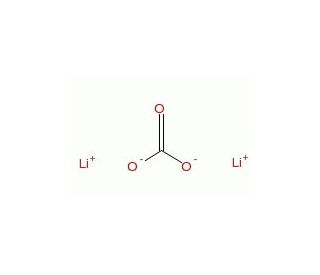

Lithium carbonate (CAS 554-13-2)
QUICK LINKS
Lithium carbonate (Li2CO3) is a white, odorless alkaline powder that is widely used in various fields of non-medical research, primarily for its properties as a stable source of lithium ions. This compound plays a significant role in the field of materials science, particularly in the development and optimization of lithium-ion batteries. Lithium carbonate is crucial in the production of lithium metal oxides, such as lithium cobalt oxide, which are key components of the cathode materials in these batteries. The lithium ions from lithium carbonate facilitate the movement of charge within the battery, contributing to the efficiency and capacity of energy storage devices. Additionally, this compound is used in the synthesis of ceramics and glasses, where it helps in lowering the melting point and viscosity of the materials, making the processing easier and enhancing the properties of the final products, such as improved durability and resistance to thermal shock. In geological sciences, lithium carbonate is employed in the study of carbonate sediments and rocks to understand climatic and environmental changes. This involves isotopic studies where lithium carbonate can be used to trace lithium isotopic signatures, helping researchers decode historical weather patterns and geological processes. These diverse applications highlight the importance of lithium carbonate in advancing research across multiple scientific domains.
Lithium carbonate (CAS 554-13-2) References
- Lithium: updated human knowledge using an evidence-based approach. Part II: Clinical pharmacology and therapeutic monitoring. | Grandjean, EM. and Aubry, JM. 2009. CNS Drugs. 23: 331-49. PMID: 19374461
- Lithium treatment arrests the development of neurofibrillary tangles in mutant tau transgenic mice with advanced neurofibrillary pathology. | Leroy, K., et al. 2010. J Alzheimers Dis. 19: 705-19. PMID: 20110614
Ordering Information
| Product Name | Catalog # | UNIT | Price | Qty | FAVORITES | |
Lithium carbonate, 100 g | sc-203109 | 100 g | $60.00 | |||
Lithium carbonate, 500 g | sc-203109A | 500 g | $150.00 |