
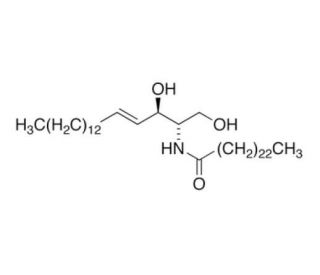

Lignoceric ceramide (CAS 34435-05-7)
Direktverknüpfungen
Lignocerinsäure-Ceramid, gekennzeichnet durch seine langkettige Lignocerinsäure (eine gesättigte Fettsäure mit 24 Kohlenstoffatomen), die mit einer Sphingosin-Base amid-verknüpft ist, ist ein entscheidender Bestandteil der Lipidmatrix im Stratum corneum der Haut sowie Teil der komplexen Lipidzusammensetzung im Nervensystem. Dieses Ceramid spielt eine wichtige Rolle bei der Aufrechterhaltung der Barrierefunktion und der strukturellen Integrität der Zellmembranen, insbesondere in der Epidermis, wo es zur Feuchtigkeitsspeicherung und zum Schutz vor Umweltfaktoren beiträgt. In der Forschung wurde lignocerisches Ceramid zur Untersuchung der biomechanischen Eigenschaften von Zellmembranen und Lipidschichten verwendet, was Einblicke in die Rolle spezifischer Ceramide bei der Zellsignalisierung und Membranstabilität ermöglicht. Sein Vorhandensein beeinflusst die Viskosität und das Phasenverhalten von Lipiddoppelschichten, die für zelluläre Prozesse wie Vesikelbildung, Fusion und das ordnungsgemäße Funktionieren von membrangebundenen Enzymen und Rezeptoren von entscheidender Bedeutung sind. Darüber hinaus tragen Untersuchungen der Wechselwirkungen von lignocerischem Ceramid mit anderen Lipidarten dazu bei, die Mechanismen aufzuklären, durch die die Lipidzusammensetzung die zelluläre Kommunikation und Stoffwechselregulierung beeinflussen kann. Solche Studien sind entscheidend für das Verständnis der biochemischen Wege, die die Zellphysiologie und die Aufrechterhaltung der zellulären Homöostase unter verschiedenen physiologischen Bedingungen steuern.
Lignoceric ceramide (CAS 34435-05-7) Literaturhinweise
- Sphingomyelinase und Ceramid-Analoga induzieren Kontraktion und Anstieg von [Ca(2+)](i) im zerebralen Gefäßmuskel von Hunden. | Zheng, T., et al. 2000. Am J Physiol Heart Circ Physiol. 278: H1421-8. PMID: 10775118
- Charakterisierung eines neuen Mitglieds der Fettsäure-bindenden Proteinfamilie, das all-trans-Retinol bindet. | Vogel, S., et al. 2001. J Biol Chem. 276: 1353-60. PMID: 11022035
- Trennung und Charakterisierung von Sphingoceramiden durch Hochleistungs-Flüssigkeitschromatographie-Elektrospray-Ionisations-Massenspektrometrie. | Camera, E., et al. 2004. J Sep Sci. 27: 971-6. PMID: 15352714
- Eine obligate Rolle der membranassoziierten neutralen Sphingomyelinase-Aktivität bei der Ausrichtung der chemotaktischen Migration menschlicher Neutrophiler. | Sitrin, RG., et al. 2011. Am J Respir Cell Mol Biol. 44: 205-12. PMID: 20378749
- Profilierung der wesentlichen Natur des Lipidstoffwechsels in asexuellen Blut- und Gametozytenstadien von Plasmodium falciparum. | Gulati, S., et al. 2015. Cell Host Microbe. 18: 371-81. PMID: 26355219
- Sphingolipidspiegel im Serum von Psoriasis-Patienten mit Fettleibigkeit. | Kozłowska, D., et al. 2019. Postepy Dermatol Alergol. 36: 714-721. PMID: 31998000
- Metabolomics von Schlafstörungen bei HIV: eine narrative Übersicht. | Balthazar, M., et al. 2020. Sleep Breath. 24: 1333-1337. PMID: 32198720
- Störungen des Lipidprofils können Psoriasis-Patienten für Leberfunktionsstörungen prädisponieren. | Kozłowska, D., et al. 2021. Postepy Dermatol Alergol. 38: 310-318. PMID: 34408599
- Die Rolle der Sphingolipide in der Pathogenese der Psoriasis. | Matwiejuk, M., et al. 2022. Metabolites. 12: PMID: 36557209
Bestellinformation
| Produkt | Katalog # | EINHEIT | Preis | ANZAHL | Favoriten | |
Lignoceric ceramide, 5 mg | sc-202694 | 5 mg | $133.00 |