
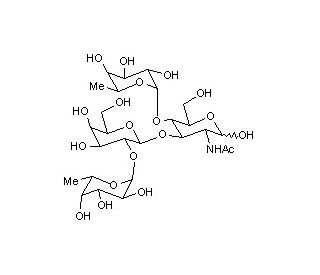

Lewis-b tetrasaccharide (CAS 80081-06-7)
QUICK LINKS
Lewis-b tetrasaccharide is a complex carbohydrate that plays a significant role in glycobiology research. Structurally, it is composed of four monosaccharide units forming a branched oligosaccharide. This tetrasaccharide motif is recognized for its involvement in cell recognition and adhesion processes due to its prevalence in cell surface glycoconjugates. It serves as a ligand for selectins, particularly E-selectin and P-selectin, which are involved in mediating leukocyte-endothelial cell interactions. This characteristic makes Lewis-b tetrasaccharide crucial in studies exploring the mechanisms of inflammation, metastasis, and immune response. In research, this carbohydrate is often synthesized or isolated for use in probing carbohydrate-protein interactions, allowing scientists to dissect the specific binding affinities and signaling pathways associated with leukocyte recruitment and pathogen recognition. Investigations also focus on its role in facilitating microbial adherence to host cells, as many pathogens exploit Lewis-b structures to gain a foothold on mucosal surfaces. Additionally, it is leveraged in developing synthetic glycoconjugates and carbohydrate arrays that mimic naturally occurring glycans, providing deeper insights into glycan-binding proteins and their implications in cellular communication and disease progression. This makes it indispensable in studying glycosylation patterns and their biological consequences.
Lewis-b tetrasaccharide (CAS 80081-06-7) References
- Utilization of natural fucosylated oligosaccharides by three novel alpha-L-fucosidases from a probiotic Lactobacillus casei strain. | Rodríguez-Díaz, J., et al. 2011. Appl Environ Microbiol. 77: 703-5. PMID: 21097595
- The effect of substituting key hydroxyl groups by amino groups on the binding of the Lewis b tetrasaccharide by a lectin and a monoclonal antibody. | Lemieux, RU., et al. 1990. Carbohydr Res. 205: C12-8. PMID: 2276127
- Characterization of H type 1 and type 1 N-acetyllactosamine glycan epitopes on ovarian cancer specifically recognized by the anti-glycan monoclonal antibody mAb-A4. | Choo, M., et al. 2017. J Biol Chem. 292: 6163-6176. PMID: 28167527
- UV-activated multilayer nanomatrix provides one-step tunable carbohydrate structural characterization in MALDI-MS. | Obena, RP., et al. 2015. Chem Sci. 6: 4790-4800. PMID: 28717486
- Fucosylated inhibitors of recently identified bangle lectin from Photorhabdus asymbiotica. | Paulíková, G., et al. 2019. Sci Rep. 9: 14904. PMID: 31624296
- Molecular basis of P[II] major human rotavirus VP8* domain recognition of histo-blood group antigens. | Xu, S., et al. 2020. PLoS Pathog. 16: e1008386. PMID: 32208455
- Lewis fucose is a key moiety for the recognition of histo-blood group antigens by GI.9 norovirus, as revealed by structural analysis. | Kimura-Someya, T., et al. 2022. FEBS Open Bio. 12: 560-570. PMID: 35038379
- Lewis b antigen is a common ligand for genogroup I norovirus strains. | Someya, Y. 2022. FEBS Open Bio. 12: 1688-1695. PMID: 35711036
- Structural analyses of the GI.4 norovirus by cryo-electron microscopy and X-ray crystallography revealing binding sites for human monoclonal antibodies. | Kimura-Someya, T., et al. 2024. J Virol. 98: e0019724. PMID: 38593321
- SPR and Double Resonance LPG Biosensors for Helicobacter pylori BabA Antigen Detection. | Dyankov, G., et al. 2024. Sensors (Basel). 24: PMID: 38610328
Ordering Information
| Product Name | Catalog # | UNIT | Price | Qty | FAVORITES | |
Lewis-b tetrasaccharide, 1 mg | sc-300916 | 1 mg | $237.00 |