
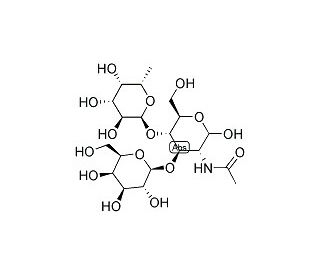

Lewis a Trisaccharide (CAS 56570-03-7)
QUICK LINKS
Lewis a trisaccharide, a carbohydrate structure consisting of three sugar units, namely N-acetylgalactosamine (GalNAc), galactose (Gal), and fucose (Fuc), plays a crucial role in various biological processes and has garnered significant attention in scientific research. One of its primary mechanisms of action lies in its involvement in cell-cell recognition and adhesion processes, particularly in the context of glycan-mediated interactions between cells and their surrounding environment. The Lewis a antigen, represented by this trisaccharide structure, is a blood group antigen found on the surface of various cells, including epithelial cells and leukocytes. It serves as a ligand for selectins, a family of cell adhesion molecules involved in leukocyte trafficking and inflammatory responses. Additionally, Lewis a trisaccharide is implicated in cancer metastasis and immune evasion mechanisms, as aberrant expression of Lewis a antigen on cancer cells facilitates their adhesion to endothelial cells and promotes metastatic spread. In research, Lewis a trisaccharide is utilized as a molecular tool to investigate the molecular basis of cell adhesion processes, glycan-protein interactions, and their implications in various physiological and pathological conditions. Furthermore, its structural elucidation and synthesis contribute to the development of novel glycan-based diagnostic tools, advancing our understanding of glycobiology and its implications in health and disease.
Lewis a Trisaccharide (CAS 56570-03-7) References
- Pre-activation of fully acetylated dodecyl thioglycosides with BSP-Tf2O led to efficient glycosylation at low temperature. | Son, SH., et al. 2009. Carbohydr Res. 344: 285-90. PMID: 19070835
- Identification of Milk and Cheese Intake Biomarkers in Healthy Adults Reveals High Interindividual Variability of Lewis System-Related Oligosaccharides. | Pimentel, G., et al. 2020. J Nutr. 150: 1058-1067. PMID: 32133503
- Structural analysis of carbohydrate binding by the macrophage mannose receptor CD206. | Feinberg, H., et al. 2021. J Biol Chem. 296: 100368. PMID: 33545173
- Lewis A Glycans Are Present on Proteins Involved in Cell Wall Biosynthesis and Appear Evolutionarily Conserved Among Natural Arabidopsis thaliana Accessions. | Beihammer, G., et al. 2021. Front Plant Sci. 12: 630891. PMID: 33777069
- Buffalo sperm membrane glycan-binding proteins reveal precise and preferential binding signatures with specific glycans targets on oviduct epithelium and zona pellucida-an implication in fertilization. | Kashyap, P., et al. 2023. Theriogenology. 207: 96-109. PMID: 37271105
Ordering Information
| Product Name | Catalog # | UNIT | Price | Qty | FAVORITES | |
Lewis a Trisaccharide, 2 mg | sc-203104 | 2 mg | $375.00 |