
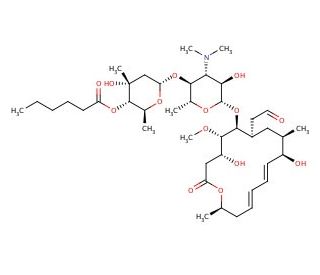

Leucomycin A13 (CAS 78897-52-6)
QUICK LINKS
Leucomycin A13, a member of the macrolide antibiotic class, has been a subject of significant scientific interest owing to its distinctive mechanism of action and potential applications in microbiology and drug discovery research. Mechanistically, Leucomycin A13 exerts its antibacterial activity by binding to the 50S ribosomal subunit of bacteria, thereby inhibiting protein synthesis. By preventing the elongation of the peptide chain during translation, Leucomycin A13 disrupts bacterial growth and proliferation. This mechanism distinguishes Leucomycin A13 from other antibiotics and renders it effective against a broad spectrum of gram-positive bacteria, including strains resistant to other antimicrobial agents. In research, Leucomycin A13 has been instrumental in elucidating the structural and functional properties of the bacterial ribosome, offering insights into the molecular mechanisms of antibiotic action and bacterial resistance. Moreover, Leucomycin A13 has been utilized as a tool in microbiological studies to investigate ribosome function, translation regulation, and bacterial physiology. Additionally, Leucomycin A13 and its derivatives have been explored for their potential applications in drug discovery efforts targeting bacterial infections and antimicrobial resistance. Ongoing research endeavors continue to explore the diverse research applications of Leucomycin A13, providing promising avenues for understanding bacterial biology and developing novel antimicrobial strategies.
Leucomycin A13 (CAS 78897-52-6) References
- First screening of biocides, persistent organic pollutants, pharmaceutical and personal care products in Antarctic phytoplankton from Deception Island by FT-ICR-MS. | Duarte, B., et al. 2021. Chemosphere. 274: 129860. PMID: 33607598
- Quantitative structure-activity relationships of O-acyl derivatives of leucomycin for antimicrobial and ribosome-binding activities. | Tanaka, H., et al. 1985. Chem Pharm Bull (Tokyo). 33: 2803-8. PMID: 4085039
Ordering Information
| Product Name | Catalog # | UNIT | Price | Qty | FAVORITES | |
Leucomycin A13, 1 mg | sc-362761 | 1 mg | $280.00 |