
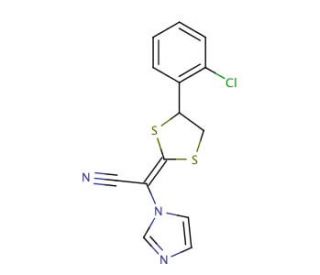

Lanoconazole (CAS 101530-10-3)
See product citations (2)
QUICK LINKS
Lanoconazole is a synthetic antifungal agent categorized within the imidazole class of compounds, known for its potent activity against a variety of fungal pathogens. Its primary mechanism of action involves the inhibition of lanosterol 14α-demethylase, a critical enzyme in the biosynthetic pathway of ergosterol, which is an essential component of the fungal cell membrane. By blocking this enzyme, lanoconazole disrupts the production of ergosterol, leading to an accumulation of toxic methylated sterol intermediates and a subsequent increase in cellular permeability, which ultimately results in fungal cell death. In research settings, lanoconazole has been extensively used to study fungal physiology and the molecular basis of antifungal resistance. This research has provided insights into the adaptive mechanisms fungi employ to survive antifungal exposure and has helped explain the pathways involved in membrane synthesis and its regulation. Furthermore, lanoconazole′s effectiveness against a broad spectrum of fungi makes it a valuable tool for mycological studies, particularly in understanding the environmental and genetic factors that influence susceptibility and resistance to antifungal compounds. Through these applications, lanoconazole not only enhances our knowledge of fungal biology but also aids in the development of effective strategies for managing fungal infections in agricultural and environmental settings.
Lanoconazole (CAS 101530-10-3) References
- Lanoconazole, a new imidazole antimycotic compound, protects MAIDS mice against encephalitis caused by Cryptococcus neoformans. | Furukawa, K., et al. 2000. J Antimicrob Chemother. 46: 443-50. PMID: 10980172
- Therapeutic efficacy of latoconazole in formulations of clinical use on experimental dermatophytosis in guinea pigs. | Oka, H., et al. 1992. Arzneimittelforschung. 42: 345-9. PMID: 1497697
- Comparison of the in vitro activity of terbinafine and lanoconazole against dermatophytes. | Ghannoum, MA., et al. 2010. Mycoses. 53: 311-3. PMID: 19422522
- Anti-inflammatory activity of lanoconazole, a topical antifungal agent. | Uratsuji, H., et al. 2015. Mycoses. 58: 197-202. PMID: 25675966
- Potent Activities of Luliconazole, Lanoconazole, and Eight Comparators against Molecularly Characterized Fusarium Species. | Abastabar, M., et al. 2018. Antimicrob Agents Chemother. 62: PMID: 29530844
- Anti-inflammatory effect of lanoconazole on 12-O-tetradecanoylphorbol-13-acetate- and 2,4,6-trinitrophenyl chloride-induced skin inflammation in mice. | Nakamura, A., et al. 2020. Mycoses. 63: 189-196. PMID: 31724251
- Allergic contact dermatitis due to clobetasol propionate and lanoconazole. | Kawai, M., et al. 2020. Contact Dermatitis. 83: 330-331. PMID: 32462741
- Eumycetoma causative agents are inhibited in vitro by luliconazole, lanoconazole and ravuconazole. | Nyuykonge, B., et al. 2022. Mycoses. 65: 650-655. PMID: 35398930
- Pharmacokinetics of lanoconazole in human skin after repeated topical application. | Imai, H., et al. 2022. J Dermatol. 49: 1118-1123. PMID: 35811383
- Therapeutic efficacy of lanoconazole, a new imidazole antimycotic agent, for experimental cutaneous candidiasis in guinea pigs. | Niwano, Y., et al. 1994. Antimicrob Agents Chemother. 38: 2204-6. PMID: 7811048
Ordering Information
| Product Name | Catalog # | UNIT | Price | Qty | FAVORITES | |
Lanoconazole, 25 mg | sc-218655 | 25 mg | $231.00 |