
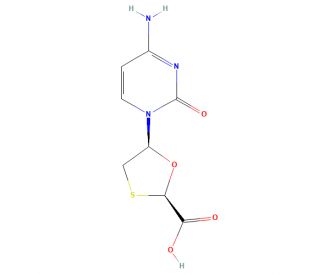

Lamivudine Acid (CAS 173829-09-9)
QUICK LINKS
Lamivudine Acid, often referred to as the carboxylic acid derivative of Lamivudine, is a compound that retains the core structure of Lamivudine but with a carboxylate group replacing the hydroxyl group at the 3′ position of the ribose sugar. This modification significantly alters its chemical properties and the way it interacts with biological molecules, making it a valuable tool in various scientific research fields. The primary mechanism of action of Lamivudine Acid in research is based on its structural similarity to Lamivudine and its ability to interact with nucleic acids and nucleic acid-processing enzymes. Unlike Lamivudine, Lamivudine Acid is not a direct analog of cytidine due to the presence of the carboxylate group, but it can still provide insight into nucleoside interaction dynamics. In scientific research, Lamivudine Acid is used to study the biochemical pathways involved in nucleoside transport and metabolism. Researchers use this compound to understand how modifications to the nucleoside structure affect its uptake and degradation by cells, which is crucial for developing more efficient methods to deliver nucleoside analogs into biological systems. Additionally, Lamivudine Acid serves as a tool to investigate the enzyme-substrate interactions, especially with enzymes involved in the phosphorylation and dephosphorylation of nucleosides. By comparing the enzyme activity with Lamivudine and Lamivudine Acid, researchers can dissect the importance of specific functional groups in enzymatic reactions and nucleoside recognition.
Ordering Information
| Product Name | Catalog # | UNIT | Price | Qty | FAVORITES | |
Lamivudine Acid, 25 mg | sc-488693 | 25 mg | $380.00 |