
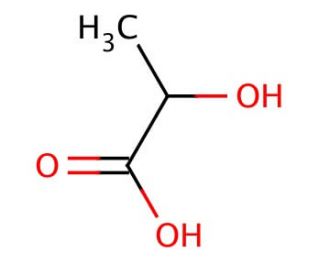

Lactic acid (CAS 50-21-5)
See product citations (1)
QUICK LINKS
Lactic acid, a naturally occurring organic acid, is ubiquitous in various organisms, including humans. It plays a vital role in numerous metabolic pathways and is a byproduct of the breakdown of carbohydrates, proteins, and fats. Found abundantly in food items like yogurt, cheese, and sourdough bread, lactic acid also serves as a significant component in the production of pharmaceuticals, cosmetics, and industrial goods. Extensively researched, lactic acid holds particular importance in biochemistry, physiology, and medicine. Its applications encompass the study of exercise effects on the body, as well as the examination of aging and disease processes. Within the body, lactic acid is primarily metabolized by the enzyme lactate dehydrogenase, which converts it into pyruvic acid. The latter is further metabolized to generate energy or stored as glycogen. Alternatively, lactic acid can undergo oxidation by lactate oxidase, leading to its conversion into carbon dioxide and water. Biochemically and physiologically, lactic acid demonstrates various effects. It promotes energy production, improves aerobic capacity, enhances muscle performance, and mitigates fatigue. Lactic acid also exhibits anti-inflammatory properties and aids in boosting immune system function.
Lactic acid (CAS 50-21-5) References
- Irradiated lactic acid-stimulated tumour cells promote the antitumour immunity as a therapeutic vaccine. | Yu, J., et al. 2020. Cancer Lett. 469: 367-379. PMID: 31734353
- Effects of lactic acid on the flexibility of the stratum corneum. | Mizukoshi, K. 2020. Skin Res Technol. 26: 599-607. PMID: 32052527
- Lactic Acid Permeation through Deep Eutectic Solvents-Based Polymer Inclusion Membranes. | Matsumoto, M., et al. 2020. Membranes (Basel). 10: PMID: 32961729
- Lactic Acid Supplementation Increases Quantity and Quality of Gametocytes in Plasmodium falciparum Culture. | West, R. and Sullivan, DJ. 2020. Infect Immun. 89: PMID: 33077626
- Magnesium Oxide-Catalyzed Conversion of Chitin to Lactic Acid. | Kun-Asa, K., et al. 2021. ChemistryOpen. 10: 308-315. PMID: 33492785
- Lactic acid production from co-fermentation of food waste and spent mushroom substance with Aspergillus niger cellulase. | Ma, X., et al. 2021. Bioresour Technol. 337: 125365. PMID: 34102515
- Lactic acid production by Carnobacterium sp. isolated from a maritime Antarctic lake using eucalyptus enzymatic hydrolysate. | Camesasca, L., et al. 2021. Biotechnol Rep (Amst). 31: e00643. PMID: 34168965
- Restricting tumor lactic acid metabolism using dichloroacetate improves T cell functions. | Rostamian, H., et al. 2022. BMC Cancer. 22: 39. PMID: 34991504
- Lactic Acid Permeability of Aquaporin-9 Enables Cytoplasmic Lactate Accumulation via an Ion Trap. | Geistlinger, K., et al. 2022. Life (Basel). 12: PMID: 35054513
- Lactic Acid Supports an Immunosuppressive Environment and Reduces ICB Response. | . 2022. Cancer Discov. 12: OF4. PMID: 35121630
- Evaluation of Nanofiltration Membranes for Pure Lactic Acid Permeability. | Cabrera-González, M., et al. 2022. Membranes (Basel). 12: PMID: 35323777
- Lactic acid production from food waste using a microbial consortium: Focus on key parameters for process upscaling and fermentation residues valorization. | Chenebault, C., et al. 2022. Bioresour Technol. 354: 127230. PMID: 35483530
- Responsive hydrogel-based three-dimensional photonic crystal sensor for lactic acid detection. | Li, Q., et al. 2022. Anal Bioanal Chem. 414: 7695-7704. PMID: 36044081
- New efficient meta-fermentation process for lactic acid production from municipal solid waste. | Acedos, MG., et al. 2022. Microb Cell Fact. 21: 233. PMID: 36335355
- Lactic acid induces HSPA1A expression through ERK1/2 activation. | Nonaka, M., et al. 2023. Biosci Biotechnol Biochem. 87: 191-196. PMID: 36441019
Ordering Information
| Product Name | Catalog # | UNIT | Price | Qty | FAVORITES | |
Lactic acid, 100 ml | sc-215227 | 100 ml | $102.00 | |||
Lactic acid, 500 ml | sc-215227A | 500 ml | $179.00 |