
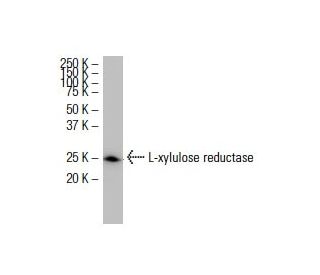


L-xylulose reductase Anticuerpo (18-Q): sc-100552
- L-xylulose reductase Anticuerpo 18-Q es un monoclonal de ratón IgG1 (kappa light chain) L-xylulose reductase Anticuerpo proporcionado como 100 µg/ml
- producido contra una proteina recombinante L-xylulose reductase de origen human
- recomendado para detectar L-xylulose reductase de human origen, mediante WB, IP, IF, IHC(P) y ELISA
- Actualmente, aún no hemos completado la identificación de los reactivos de detección secundaria preferidos para L-xylulose reductase Anticuerpo (18-Q). Este trabajo está en progreso.

ENLACES RÁPIDOS
VER TAMBIÉN ....
El anticuerpo L-xylulose reductase (18-Q) es un anticuerpo monoclonal de ratón IgG1 κ que detecta la proteína L-xylulose reductase de origen humano mediante WB, IP, IF, IHC(P) y ELISA. Este anticuerpo está disponible como anticuerpo anti-L-xylulose reductase no conjugado. La L-xylulose reductase (XR), también conocida como dicarbonilo reductasa del riñón (kiDCR) o proteína de superficie espermática P34H, es un miembro de 244 aminoácidos de la familia de deshidrogenasas/reductasas de cadena corta. Esta proteína de membrana periférica cataliza la reducción dependiente de NADPH de múltiples azúcares, incluyendo L-xylulose, al osmolito xilitol. La producción de xilitol en los túbulos renales puede prevenir el estrés osmótico. La L-xylulose reductase funciona como un homotetrámero y se expresa en gran medida en el riñón, hígado y epidídimo. La pentosuria esencial es el resultado de una deficiencia parcial de L-xylulose reductase. Los glóbulos rojos de individuos normales contienen dos L-xylulose reductasas: una isoenzima mayor y una menor. Los glóbulos rojos de pacientes con pentosuria contienen solo una isoenzima. Debido a su papel en el ciclo de uronato del metabolismo de la glucosa, la L-xylulose reductase ha sido implicada en el manejo de las complicaciones a largo plazo de la diabetes.
Alexa Fluor® es una marca registrada de Molecular Probes Inc., OR., USA
REIVEW LI-COR® y Odyssey® son marcas registradas de LI-COR Biosciences.
L-xylulose reductase Anticuerpo (18-Q) Referencias:
- Identificación de residuos de aminoácidos implicados en el reconocimiento de sustrato de la L-xilulosa reductasa mediante mutagénesis dirigida al sitio. | Ishikura, S., et al. 2003. Chem Biol Interact. 143-144: 543-50. PMID: 12604240
- Determinante estructural de la inactivación por frío de la L-xilulosa reductasa de roedores. | Ishikura, S., et al. 2003. Biochem Biophys Res Commun. 308: 68-72. PMID: 12890481
- Diferentes fenotipos clínicos y morfológicos en gemelos monocigóticos con idéntica mutación DCX. | Martin, P., et al. 2004. J Neurol. 251: 108-10. PMID: 14999500
- Estructura cristalina de la holoenzima de la L-xilulosa reductasa humana: sondeo del papel de la Asn107 mediante mutagénesis dirigida. | El-Kabbani, O., et al. 2004. Proteins. 55: 724-32. PMID: 15103634
- La P26h y la dicarbonil/L-xilulosa reductasa son dos proteínas distintas presentes en el epidídimo del hámster. | St-Cyr, A., et al. 2004. Mol Reprod Dev. 69: 137-45. PMID: 15293214
- Estructura de la forma tetramérica de la L-xilulosa reductasa humana: sondeo del sitio de unión al inhibidor mediante modelización molecular y mutagénesis dirigida al sitio. | El-Kabbani, O., et al. 2005. Proteins. 60: 424-32. PMID: 15906319
- Supresión de la formación de precursores de AGE tras la obstrucción ureteral unilateral en riñones de ratón mediante la expresión transgénica de alfa-dicarbonil/L-xilulosa reductasa. | Asami, J., et al. 2006. Biosci Biotechnol Biochem. 70: 2899-905. PMID: 17151462
- Sobre la naturaleza de la deficiencia de L-xilulosa reductasa en la pentosuria esencial. | Lane, AB. 1985. Biochem Genet. 23: 61-72. PMID: 3994659
- Descubrimiento basado en la estructura de inhibidores de la L-xilulosa reductasa humana a partir del cribado de bases de datos y el acoplamiento molecular. | Carbone, V., et al. 2005. Bioorg Med Chem. 13: 301-12. PMID: 15598553
Información sobre pedidos
| Nombre del producto | Número de catálogo | UNIDAD | Precio | CANTIDAD | Favoritos | |
L-xylulose reductase Anticuerpo (18-Q) | sc-100552 | 100 µg/ml | $322.00 |