
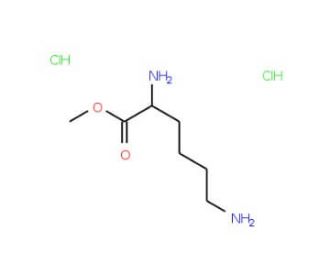

Molecular structure of L-Lysine Methyl Ester Dihydrochloride, CAS Number: 26348-70-9
L-Lysine Methyl Ester Dihydrochloride (CAS 26348-70-9)
Alternate Names:
L-Lys-OMe⋅2HCl
CAS Number:
26348-70-9
Molecular Weight:
233.14
Molecular Formula:
C7H18Cl2N2O2
For Research Use Only. Not Intended for Diagnostic or Therapeutic Use.
* Refer to Certificate of Analysis for lot specific data.
QUICK LINKS
Ordering Information
Description
Technical Information
Safety Information
SDS & Certificate of Analysis
L-Lysine Methyl Ester Dihydrochloride is a water-soluble white substance, either in powder or crystalline form. It is a modified version of lysine, an essential amino acid required for human protein production. Often employed in scientific research, this compound carries a positive charge, allowing it to engage with negatively charged molecules like DNA and RNA. The substance is used to explore interactions between DNA and RNA, as well as between different proteins. Used in the synthesis of peptides containing histidine and lysine.
L-Lysine Methyl Ester Dihydrochloride (CAS 26348-70-9) References
- Polysaccharide-polynucleotide complexes (15): thermal stability of schizophyllan (SPG)/poly(C) triple strands is controllable by alpha-amino acid modification. | Numata, M., et al. 2003. Bioorg Chem. 31: 163-71. PMID: 12729573
- Synthesis and in vitro drug release behavior of amphiphilic triblock copolymer nanoparticles based on poly (ethylene glycol) and polycaprolactone. | Zhang, Y. and Zhuo, RX. 2005. Biomaterials. 26: 6736-42. PMID: 15935469
- Tridentate lysine-based fluorescent sensor for Hg(II) in aqueous solution. | Chen, L., et al. 2011. Inorg Chem. 50: 10028-32. PMID: 21905752
- Squaric acid mediated chemoselective PEGylation of proteins: reactivity of single-step-activated α-amino poly(ethylene glycol)s. | Dingels, C., et al. 2012. Chemistry. 18: 16828-35. PMID: 23135990
- pH-responsive, lysine-based hydrogels for the oral delivery of a wide size range of molecules. | Watkins, KA. and Chen, R. 2015. Int J Pharm. 478: 496-503. PMID: 25490181
- Dextran hydrogels by crosslinking with amino acid diamines and their viscoelastic properties. | O'Connor, NA., et al. 2018. Int J Biol Macromol. 111: 370-378. PMID: 29325744
- Chiral ligand exchange capillary electrochromatography with dual ligands for enantioseparation of D,L-amino acids. | Feng, W., et al. 2019. Talanta. 194: 430-436. PMID: 30609554
- A bis (crown-ether) analogue of Tröger's base: Recognition of achiral and chiral primary bisammonium salts | Hansson, A. P., Norrby, P. O., & Wärnmark, K. 1998. Tetrahedron letters. 39(25): 4565-4568.
- Synthesis of a methacrylic monomer containing an L-lysine-based dendron | Khimich, G. N., & Tennikova, T. B. 2005. Russian journal of applied chemistry. 78: 1003-1007.
- L-Lysine-linked anthracenophane derived from thermodynamically controlled intermediates | Kutsumizu, R., Shinmori, H., & Takeuchi, T. 2007. Tetrahedron letters. 48(18): 3225-3228.
- Exploring molecular recognition pathways within a family of gelators with different hydrogen bonding motifs | Hardy, J. G., Hirst, A. R., Ashworth, I., Brennan, C., & Smith, D. K. 2007. Tetrahedron. 63(31): 7397-7406.
- Synthesis and application of a novel lysine-based polyol for preparation of polyurethane | , et al. 2014. Monatshefte für Chemie - Chemical Monthly volume. 145: 79–84.
- Zwitterionic polyaspartamides based on L-lysine side-chain moieties: Synthesis, nonfouling properties and direct/indirect nanogel preparation | S Hladysh, D Oleshchuk, J Dvořáková. 2021. European Polymer Journal. 148: 110347.
Ordering Information
| Product Name | Catalog # | UNIT | Price | Qty | FAVORITES | |
L-Lysine Methyl Ester Dihydrochloride, 5 g | sc-211706 | 5 g | $62.00 |