
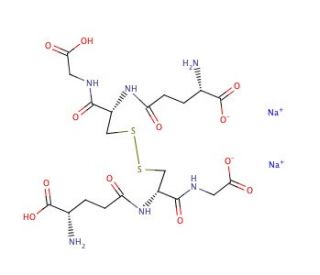

L-Glutathione oxidized disodium salt (CAS 103239-24-3)
QUICK LINKS
L-Glutathione oxidized disodium salt, commonly referred to as GSSG, is a pivotal chemical in biochemical research, particularly in studies focused on oxidative stress and redox biology. GSSG is the oxidized form of glutathione (GSH), a tripeptide consisting of glutamate, cysteine, and glycine. This oxidized variant is crucial in the glutathione redox cycle, a fundamental cellular process that protects against oxidative damage. The primary mechanism of action of GSSG in research involves its role in maintaining the redox state within cells. In oxidative conditions, two molecules of reduced glutathione (GSH) react with reactive oxygen species (ROS) and are oxidized to form GSSG. The ratio of GSSG to GSH within cells is often used as a marker of oxidative stress, with higher ratios indicating increased cellular oxidation. Furthermore, GSSG is employed in experimental setups to artificially modulate the redox environment of cells, thereby studying the responses of various cellular pathways to oxidative stress. It has been used in studies to induce a controlled oxidative environment, which helps in understanding how cells adapt to and manage increased oxidative conditions.
L-Glutathione oxidized disodium salt (CAS 103239-24-3) References
- Methods for the determination of plasma or tissue glutathione levels. | Tipple, TE. and Rogers, LK. 2012. Methods Mol Biol. 889: 315-24. PMID: 22669674
- Glutathione and Inter-α-trypsin inhibitor heavy chain 3 (Itih3) mRNA levels in nicotine-treated Cd44 knockout mice. | Wickramasekara, RN., et al. 2018. Toxicol Rep. 5: 759-764. PMID: 29984189
- Transsulfuration Activity Can Support Cell Growth upon Extracellular Cysteine Limitation. | Zhu, J., et al. 2019. Cell Metab. 30: 865-876.e5. PMID: 31607565
- Zinc and Copper with New Triazine Hydrazone Ligand: Two Novel Organic Complexes Enhanced Expression of Peptide Growth Factors and Cytokine Genes in Weaned V-Line Rabbit. | Elokil, AA., et al. 2019. Animals (Basel). 9: PMID: 31842499
- Ultrasensitive Genetically Encoded Indicator for Hydrogen Peroxide Identifies Roles for the Oxidant in Cell Migration and Mitochondrial Function. | Pak, VV., et al. 2020. Cell Metab. 31: 642-653.e6. PMID: 32130885
- Effect of alpha-lipoic acid during preimplantation development of cattle embryos when there were different in vitro culture conditions. | Fabra, MC., et al. 2020. Anim Reprod Sci. 221: 106550. PMID: 32861112
- Measurement of Ascorbic Acid and Glutathione Content in Cyanobacterium Synechocystis sp. PCC 6803. | Aguilera, A., et al. 2020. Bio Protoc. 10: e3800. PMID: 33659454
- Supplementing rabbit diets with butylated hydroxyanisole affects oxidative stress, growth performance, and meat quality. | Imbabi, T., et al. 2021. Animal. 15: 100339. PMID: 34425485
- Pesticides diazinon and diuron increase glutathione levels and affect multixenobiotic resistance activity and biomarker responses in zebrafish (Danio rerio) embryos and larvae | Velki, M., et al. 2019. Environmental Sciences Europe. 31: 1-18.
- Synthesis and characterization of redox-sensitive polyurethanes based on L-glutathione oxidized and poly (ether ester) triblock copolymers | Palumbo, F. S., et al. 2021. Reactive and Functional Polymers. 166: 104986.
Ordering Information
| Product Name | Catalog # | UNIT | Price | Qty | FAVORITES | |
L-Glutathione oxidized disodium salt, 250 mg | sc-235472 | 250 mg | $74.00 | |||
L-Glutathione oxidized disodium salt, 1 g | sc-235472A | 1 g | $210.00 |