
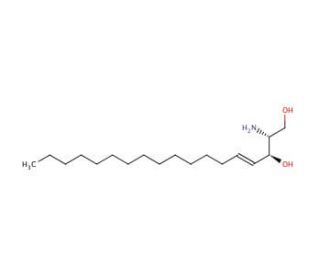

L-erythro-Sphingosine (synthetic) (CAS 6036-75-5)
ENLACES RÁPIDOS
La L-eritroesfingosina, un esfingolípido natural, desempeña un papel fundamental en los aspectos estructurales y de señalización de las membranas celulares. Como lípido bioactivo, participa en la formación de esfingomielina y glicoesfingolípidos, que son componentes críticos de la bicapa lipídica. La estructura de la L-eritrosfingosina le permite influir en la fluidez de la membrana y en la organización de los microdominios (balsas lipídicas), que son esenciales para modular la función de los receptores y las vías de transducción de señales. En investigación, este compuesto se ha utilizado ampliamente para estudiar su capacidad intrínseca de regular estas vías, en particular las relacionadas con el crecimiento y la supervivencia celular. El esqueleto de esfingosina de la L-eritrosfingosina permite la incorporación de diversos ácidos grasos, que pueden afectar a su comportamiento en las membranas biológicas y a su interacción con proteínas específicas, como los receptores de esfingosina-1-fosfato. Al alterar las cascadas de señalización intracelular, los investigadores pueden observar cambios en las respuestas celulares, lo que permite comprender mejor los mecanismos de acción de los esfingolípidos en la regulación celular. Además, su papel en la influencia de la apoptosis y la senescencia celular es de gran interés para comprender el proceso de envejecimiento celular y el mantenimiento de la homeostasis celular, lo que convierte a la L-eritroesfingosina en una valiosa herramienta en el campo de la biología celular y molecular.
L-erythro-Sphingosine (synthetic) (CAS 6036-75-5) Referencias
- Caracterización bioquímica de la actividad inversa de la ceramidasa de cerebro de rata. Una ceramida sintasa independiente de CoA e insensible a la fumonisina B1. | El Bawab, S., et al. 2001. J Biol Chem. 276: 16758-66. PMID: 11278489
- Síntesis quimioenzimática de los cuatro estereoisómeros de la esfingosina a partir del clorobenceno: Precursores de Glicoesfingolípidos(1)(a). | Nugent, TC. and Hudlicky, T. 1998. J Org Chem. 63: 510-520. PMID: 11672039
- La esfingosina puede preacondicionar y posacondicionar el corazón y utiliza un mecanismo diferente al de la esfingosina 1-fosfato. | Vessey, DA., et al. 2008. J Biochem Mol Toxicol. 22: 113-8. PMID: 18418901
- Esfingo-guanidinas y su uso como inhibidores de la esfingosina cinasa (WO2010078247). | Sharma, AK. 2011. Expert Opin Ther Pat. 21: 807-12. PMID: 21457086
- Evaluación de las propiedades quimioterapéuticas y protectoras contra el cáncer de la esfingosina y la C2-ceramida en un modelo de carcinogénesis derivado de células madre de mama humanas. | Ahn, EH., et al. 2019. Int J Oncol. 54: 655-664. PMID: 30483770
- Una serie de N-acilsfingosinas fluorescentes: síntesis, propiedades físicas y estudios en células cultivadas. | Pagano, RE. and Martin, OC. 1988. Biochemistry. 27: 4439-45. PMID: 3166987
- Síntesis total de esfingosina y ceramida estereoespecíficas. | Shoyama, Y., et al. 1978. J Lipid Res. 19: 250-9. PMID: 632688
- La estereoselectividad de la inducción de la desfosforilación del producto génico del retinoblastoma (pRb) por la D-eritroesfingosina apoya el papel de la pRb en la supresión del crecimiento por la esfingosina. | Pushkareva, M., et al. 1995. Biochemistry. 34: 1885-92. PMID: 7849048
- Regulación de las proteínas quinasas activadas por esfingosina: selectividad de la activación por bases esfingoides e inhibición por ácidos grasos no esterificados. | Pushkareva MYu, ., et al. 1993. Biochem J. 294 (Pt 3): 699-703. PMID: 8379926
- El gen BST1 de Saccharomyces cerevisiae es la esfingosina-1-fosfato liasa. | Saba, JD., et al. 1997. J Biol Chem. 272: 26087-90. PMID: 9334171
Información sobre pedidos
| Nombre del producto | Número de catálogo | UNIDAD | Precio | CANTIDAD | Favoritos | |
L-erythro-Sphingosine (synthetic), 5 mg | sc-202687 | 5 mg | $6400.00 |