
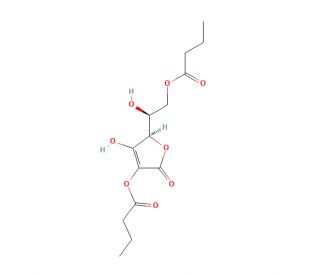

L-Ascorbyl 2,6-Dibutyrate (CAS 4337-04-6)
QUICK LINKS
L-Ascorbyl 2,6-dibutyrate, a derivative of vitamin C, has been extensively studied in scientific research for its antioxidant properties and potential applications in various fields. Studies have investigated its mechanism of action, revealing its ability to scavenge free radicals and protect cells from oxidative stress-induced damage. This compound has been utilized in research exploring its role in skin biology, particularly in the context of photoprotection and anti-aging effects. L-Ascorbyl 2,6-dibutyrate has been shown to enhance collagen synthesis and inhibit the formation of reactive oxygen species (ROS) induced by UV radiation, suggesting its potential as a photoprotective agent in skincare formulations. Additionally, research has focused on its use in food preservation, where it acts as an antioxidant to prevent lipid oxidation and extend the shelf life of food products. Furthermore, L-Ascorbyl 2,6-dibutyrate has been investigated for its potential as a drug delivery vehicle, exploiting its ability to undergo hydrolysis in vivo to release active vitamin C. By elucidating the mechanisms of action and exploring its diverse applications, researchers aim to further understand the potential benefits of L-Ascorbyl 2,6-dibutyrate in various scientific disciplines, including skincare, food science, and pharmaceuticals.
L-Ascorbyl 2,6-Dibutyrate (CAS 4337-04-6) References
- Anti- and pro-oxidant effects of oxidized quercetin, curcumin or curcumin-related compounds with thiols or ascorbate as measured by the induction period method. | Fujisawa, S. and Kadoma, Y. 2006. In Vivo. 20: 39-44. PMID: 16433026
- A quantitative approach to the free radical interaction between alpha-tocopherol and the coantioxidants eugenol, resveratrol or ascorbate. | Kadoma, Y., et al. 2006. In Vivo. 20: 61-7. PMID: 16433030
- A quantitative approach to the free radical interaction between alpha-tocopherol or ascorbate and flavonoids. | Fujisawa, S., et al. 2006. In Vivo. 20: 445-52. PMID: 16900773
- Free radical interaction between vitamin E (alpha-, beta-, gamma- and delta-tocopherol), ascorbate and flavonoids. | Kadoma, Y., et al. 2006. In Vivo. 20: 823-7. PMID: 17203774
- Countercurrent Chromatographic Separation of Lipophilic Ascorbic Acid Derivatives and Extract from Kadsura Coccinea Using Hydrophobic Organic-Aqueous Two-Phase Solvent Systems. | Shinomiya, K., et al. 2009. J Liq Chromatogr Relat Technol. 32: 2361-2371. PMID: 20046934
- Radical-scavenging activity of melatonin, either alone or in combination with vitamin E, ascorbate or 2-mercaptoethanol as co-antioxidants, using the induction period method. | Kadoma, Y. and Fujisawa, S. 2011. In Vivo. 25: 49-53. PMID: 21282734
- Dietary antioxidant synergy in chemical and biological systems. | Wang, S. and Zhu, F. 2017. Crit Rev Food Sci Nutr. 57: 2343-2357. PMID: 26176981
- Ascorbic Acid Derivatives as Potential Substitutes for Ascorbic Acid To Reduce Color Degradation of Drinks Containing Ascorbic Acid and Anthocyanins from Natural Extracts. | Gérard, V., et al. 2019. J Agric Food Chem. 67: 12061-12071. PMID: 31588743
- Combinatorial approach of vitamin C derivative and anti-HIV drug-darunavir against SARS-CoV-2. | Sahoo, A., et al. 2022. Front Biosci (Landmark Ed). 27: 10. PMID: 35090315
- Vitamin C for COVID-19 Treatment: Have We Got Enough Evidence? | Ahmad, SR. 2022. Front Nutr. 9: 892561. PMID: 35662927
Ordering Information
| Product Name | Catalog # | UNIT | Price | Qty | FAVORITES | |
L-Ascorbyl 2,6-Dibutyrate, 1 g | sc-295261 | 1 g | $255.00 |