
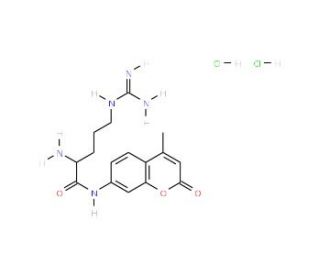

L-Arginine 7-amido-4- methylcoumarin dihydrochloride (CAS 113712-08-6)
QUICK LINKS
L-Arginine 7-amido-4-methylcoumarin dihydrochloride, a compound widely utilized in scientific research, serves as an exceptional fluorogenic substrate for cathepsin H, enabling precise quantification of its activity. This chemical substrate proves valuable for aminopeptidase B, CD13 (pepN), pepC, and Trypsin as well, yielding a blue fluorescent solution upon cleavage. L-Arginine 7-amido-4-methylcoumarin dihydrochloride, also referred to as L-Arg-AMC-Cl, represents a synthetic compound derived from L-arginine, a naturally occurring amino acid, and 4-methylcoumarin, a derivative of coumarin. In scientific research, L-Arg-AMC-Cl finds diverse applications, including the study of protein-protein interactions, enzyme kinetics, and receptor binding. It serves as a fluorescent probe facilitating investigations into the structure and function of proteins, nucleic acids, and other biomolecules. Furthermore, L-Arg-AMC-Cl serves as a fluorescent marker for cell imaging and tracking. The mechanism of action of L-Arg-AMC-Cl revolves around its ability to interact with proteins and other biomolecules. The compound possesses an L-arginine moiety capable of binding to amino acid residues on proteins, along with a 4-methylcoumarin moiety that can bind to nucleic acids. Upon binding to proteins and biomolecules, the fluorescence of L-Arg-AMC-Cl undergoes changes that can be detected through fluorescence spectroscopy. While the complete understanding of the biochemical and physiological effects of L-Arg-AMC-Cl remains elusive, studies have demonstrated its interactions with proteins, biomolecules, and receptors. These interactions may impact their structure, function, and potentially induce alterations in cellular signaling pathways.
L-Arginine 7-amido-4- methylcoumarin dihydrochloride (CAS 113712-08-6) References
- Necator americanus (human hookworm) aspartyl proteinases and digestion of skin macromolecules during skin penetration. | Brown, A., et al. 1999. Am J Trop Med Hyg. 60: 840-7. PMID: 10344662
- Degradation of extracellular matrix components by defined proteinases from the greenbottle larva Lucilia sericata used for the clinical debridement of non-healing wounds. | Chambers, L., et al. 2003. Br J Dermatol. 148: 14-23. PMID: 12534589
- Maggots and wound healing: an investigation of the effects of secretions from Lucilia sericata larvae upon the migration of human dermal fibroblasts over a fibronectin-coated surface. | Horobin, AJ., et al. 2005. Wound Repair Regen. 13: 422-33. PMID: 16008732
- Fluorogenic peptide-based substrates for monitoring thrombin activity. | van Berkel, SS., et al. 2012. ChemMedChem. 7: 606-17. PMID: 22294421
- Identification of the first synthetic inhibitors of the type II transmembrane serine protease TMPRSS2 suitable for inhibition of influenza virus activation. | Meyer, D., et al. 2013. Biochem J. 452: 331-43. PMID: 23527573
- Design, synthesis, and characterization of novel fluorogenic substrates of the proprotein convertases furin, PC1/3, PC2, PC5/6, and PC7. | Lam van, TV., et al. 2022. Anal Biochem. 655: 114836. PMID: 35964735
Ordering Information
| Product Name | Catalog # | UNIT | Price | Qty | FAVORITES | |
L-Arginine 7-amido-4- methylcoumarin dihydrochloride, 100 mg | sc-281539 | 100 mg | $139.00 | |||
L-Arginine 7-amido-4- methylcoumarin dihydrochloride, 250 mg | sc-281539A | 250 mg | $243.00 |