
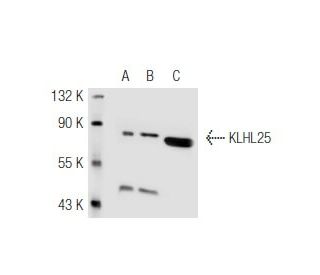


KLHL25 Antibody (K-20): sc-100774
- KLHL25 Antibody (K-20) is a mouse monoclonal IgG2a κ KLHL25 antibody, cited in 1 publications, provided at 100 µg/ml
- raised against recombinant KLHL25 of human origin
- recommended for detection of KLHL25 of mouse, rat and human origin by WB, IP and ELISA
- At present, we have not yet completed the identification of the preferred secondary detection reagent(s) for KLHL25 Antibody (K-20). This work is in progress.

KLHL25 Antibody (K-20) is a mouse monoclonal IgG2a kappa light chain antibody that detects KLHL25 protein of mouse, rat, and human origin by western blotting (WB), immunoprecipitation (IP), and enzyme-linked immunosorbent assay (ELISA). Anti-KLHL25 antibody (K-20) is available as a non-conjugated format. KLHL25, also known as Ectoderm-neural cortex protein 2 (ENC2), is a cytoplasmic protein characterized by six Kelch repeats and a single BTB (POZ) domain, which are crucial for cellular processes. KLHL25 is highly homologous to another Kelch-like protein, ENC1, and operates similarly to other Kelch-domain containing proteins, which often serve as modifiers of actin fibers. KLHL25 expression is particularly prominent during early embryogenesis, playing a significant role in neuronal process formation and neural crest cell differentiation. KLHL25 functions as a substrate-specific adapter for protein ubiquitinating complexes, highlighting its importance in regulating protein degradation pathways. KLHL25 is expressed in various tissues, with highest levels found in brain and liver, underscoring its potential involvement in critical physiological processes within these organs.
Alexa Fluor® is a trademark of Molecular Probes Inc., OR., USA
LI-COR® and Odyssey® are registered trademarks of LI-COR Biosciences
KLHL25 Antibody (K-20) References:
- The KLHL12-Cullin-3 ubiquitin ligase negatively regulates the Wnt-beta-catenin pathway by targeting Dishevelled for degradation. | Angers, S., et al. 2006. Nat Cell Biol. 8: 348-57. PMID: 16547521
- Kelch-repeat proteins interacting with the Galpha protein Gpa2 bypass adenylate cyclase for direct regulation of protein kinase A in yeast. | Peeters, T., et al. 2006. Proc Natl Acad Sci U S A. 103: 13034-9. PMID: 16924114
- KLHL1/MRP2 mediates neurite outgrowth in a glycogen synthase kinase 3beta-dependent manner. | Seng, S., et al. 2006. Mol Cell Biol. 26: 8371-84. PMID: 16982692
- The Kelch-like protein 1 modulates P/Q-type calcium current density. | Aromolaran, KA., et al. 2007. Neuroscience. 145: 841-50. PMID: 17289272
- The BTB-Kelch protein KLEIP controls endothelial migration and sprouting angiogenesis. | Nacak, TG., et al. 2007. Circ Res. 100: 1155-63. PMID: 17395875
- Kelch repeat protein interacts with the yeast Galpha subunit Gpa2p at a site that couples receptor binding to guanine nucleotide exchange. | Niranjan, T., et al. 2007. J Biol Chem. 282: 24231-8. PMID: 17584745
- Directly from Galpha to protein kinase A: the kelch repeat protein bypass of adenylate cyclase. | Peeters, T., et al. 2007. Trends Biochem Sci. 32: 547-54. PMID: 17983752
- Ectromelia virus BTB/kelch proteins, EVM150 and EVM167, interact with cullin-3-based ubiquitin ligases. | Wilton, BA., et al. 2008. Virology. 374: 82-99. PMID: 18221766
- BTB Protein KLHL12 targets the dopamine D4 receptor for ubiquitination by a Cul3-based E3 ligase. | Rondou, P., et al. 2008. J Biol Chem. 283: 11083-96. PMID: 18303015
- ENC-1: a novel mammalian kelch-related gene specifically expressed in the nervous system encodes an actin-binding protein. | Hernandez, MC., et al. 1997. J Neurosci. 17: 3038-51. PMID: 9096139
Ordering Information
| Product Name | Catalog # | UNIT | Price | Qty | FAVORITES | |
KLHL25 Antibody (K-20) | sc-100774 | 100 µg/ml | $339.00 |