
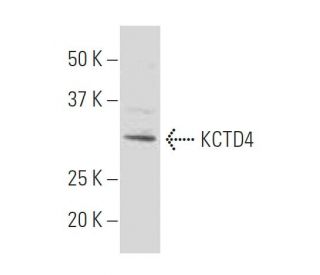

KCTD4 Antibody (NN-07): sc-100998
- KCTD4 Antibody (NN-07) is a mouse monoclonal IgG2b κ KCTD4 antibody provided at 50 µg/0.5 ml
- raised against recombinant KCTD4 of human origin
- recommended for detection of KCTD4 of mouse, rat and human origin by WB, IP and ELISA
- At present, we have not yet completed the identification of the preferred secondary detection reagent(s) for KCTD4 Antibody (NN-07). This work is in progress.

KCTD4 Antibody (NN-07) is a mouse monoclonal IgG2b kappa light chain antibody that detects KCTD4 protein of mouse, rat, and human origin by western blotting (WB), immunoprecipitation (IP), and enzyme-linked immunosorbent assay (ELISA). Anti-KCTD4 antibody (NN-07) is available as a non-conjugated format. KCTD4 protein consists of 259 amino acids and features a BTB (Broad-Complex, Tramtrack and Bric a brac) domain, also known as a POZ (POxvirus and Zinc finger) domain, playing a crucial role in homodimerization and is characterized by multiple kelch repeats and/or C2H2-type zinc fingers. This structural feature suggests KCTD4 may function as a transcriptional regulator, influencing gene expression by modulating chromatin structure and function. KCTD4′s ability to interact with various proteins involved in transcriptional regulation highlights KCTD4′s importance in cellular processes, including development and differentiation. KCTD4 monoclonal antibody (NN-07) enables researchers to gain valuable insights into regulatory mechanisms of gene expression and potential implications in various biological contexts.
Alexa Fluor® is a trademark of Molecular Probes Inc., OR., USA
LI-COR® and Odyssey® are registered trademarks of LI-COR Biosciences
KCTD4 Antibody (NN-07) References:
- Towards a proteome-scale map of the human protein-protein interaction network. | Rual, JF., et al. 2005. Nature. 437: 1173-8. PMID: 16189514
- Diversification of transcriptional modulation: large-scale identification and characterization of putative alternative promoters of human genes. | Kimura, K., et al. 2006. Genome Res. 16: 55-65. PMID: 16344560
- Pentameric assembly of potassium channel tetramerization domain-containing protein 5. | Dementieva, IS., et al. 2009. J Mol Biol. 387: 175-91. PMID: 19361449
- PrPC interacts with potassium channel tetramerization domain containing 1 (KCTD1) protein through the PrP(51-136) region containing octapeptide repeats. | Huang, T., et al. 2012. Biochem Biophys Res Commun. 417: 182-6. PMID: 22138399
- Identification of new genes of pleomorphic adenoma. | Choi, JS., et al. 2019. Medicine (Baltimore). 98: e18468. PMID: 31861025
- Evaluation of cfDNA as an early detection assay for dense tissue breast cancer. | Barbirou, M., et al. 2022. Sci Rep. 12: 8458. PMID: 35589867
- Alphafold Predictions Provide Insights into the Structural Features of the Functional Oligomers of All Members of the KCTD Family. | Esposito, L., et al. 2022. Int J Mol Sci. 23: PMID: 36362127
- KCTD4 interacts with CLIC1 to disrupt calcium homeostasis and promote metastasis in esophageal cancer. | Zheng, C., et al. 2023. Acta Pharm Sin B. 13: 4217-4233. PMID: 37799381
- Effects of Mitochondrial Transplantation on Transcriptomics in a Polymicrobial Sepsis Model. | Kim, S., et al. 2023. Int J Mol Sci. 24: PMID: 37895006
- The BTB domain, found primarily in zinc finger proteins, defines an evolutionarily conserved family that includes several developmentally regulated genes in Drosophila. | Zollman, S., et al. 1994. Proc Natl Acad Sci U S A. 91: 10717-21. PMID: 7938017
- The POZ domain: a conserved protein-protein interaction motif. | Bardwell, VJ. and Treisman, R. 1994. Genes Dev. 8: 1664-77. PMID: 7958847
- Crystal structure of the BTB domain from PLZF. | Ahmad, KF., et al. 1998. Proc Natl Acad Sci U S A. 95: 12123-8. PMID: 9770450
Ordering Information
| Product Name | Catalog # | UNIT | Price | Qty | FAVORITES | |
KCTD4 Antibody (NN-07) | sc-100998 | 50 µg/0.5 ml | $322.00 |