
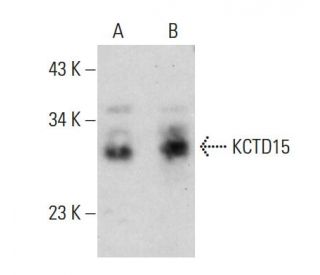

KCTD15 Antibody (AT4C3): sc-517410
- KCTD15 Antibody (AT4C3) is a mouse monoclonal IgG3 KCTD15 antibody provided at 100 µg/ml
- raised against a recombinant protein corresponding to amino acids 1-234 of KCTD15 of human origin
- recommended for detection of KCTD15 of human origin by WB, IP, IF, FCM and ELISA
- At present, we have not yet completed the identification of the preferred secondary detection reagent(s) for KCTD15 Antibody (AT4C3). This work is in progress.

KCTD15 Antibody (AT4C3) is a mouse monoclonal IgG3 antibody that detects KCTD15 protein of human origin by western blotting (WB), immunoprecipitation (IP), immunofluorescence (IF), flow cytometry (FCM), and enzyme-linked immunosorbent assay (ELISA). Anti-KCTD15 antibody (AT4C3) is available as non-conjugated format. KCTD15 protein, consisting of 283 amino acids, features a single BTB (POZ) domain and exists in two alternatively spliced isoforms, which may have distinct functional roles in cellular processes. KCTD15 gene is located on human chromosome 19q13.11, a region spanning approximately 18,918 bases and rich in genes associated with various biological functions, including those related to immune system and pigmentation. KCTD15 presence in cytoplasm suggests involvement in cellular signaling pathways, particularly in neuronal development and function regulation. KCTD15 role understanding is crucial, as KCTD15 has been implicated in several neurological disorders, highlighting potential as a therapeutic target. Additionally, chromosome 19 houses over 1,400 genes and links to various conditions such as Peutz-Jeghers syndrome and spinocerebellar ataxia type 6, making KCTD15 study and interactions particularly relevant in human health and disease context.
Alexa Fluor® is a trademark of Molecular Probes Inc., OR., USA
LI-COR® and Odyssey® are registered trademarks of LI-COR Biosciences
KCTD15 Antibody (AT4C3) References:
- C-CAM1, a candidate tumor suppressor gene, is abnormally expressed in primary lung cancers. | Wang, L., et al. 2000. Clin Cancer Res. 6: 2988-93. PMID: 10955775
- The genomic context of natural killer receptor extended gene families. | Trowsdale, J., et al. 2001. Immunol Rev. 181: 20-38. PMID: 11513141
- Complete germline deletion of the STK11 gene in a family with Peutz-Jeghers syndrome. | Le Meur, N., et al. 2004. Eur J Hum Genet. 12: 415-8. PMID: 14970844
- Comparative human-mouse-rat sequence analysis of the ICAM gene cluster on HSA 19p13.2 and a 185-kb porcine region from SSC 2q. | Leeb, T. and Müller, M. 2004. Gene. 343: 239-44. PMID: 15588578
- The extended human leukocyte receptor complex: diverse ways of modulating immune responses. | Barrow, AD. and Trowsdale, J. 2008. Immunol Rev. 224: 98-123. PMID: 18759923
- Implication of genetic variants near NEGR1, SEC16B, TMEM18, ETV5/DGKG, GNPDA2, LIN7C/BDNF, MTCH2, BCDIN3D/FAIM2, SH2B1, FTO, MC4R, and KCTD15 with obesity and type 2 diabetes in 7705 Chinese. | Ng, MC., et al. 2010. J Clin Endocrinol Metab. 95: 2418-25. PMID: 20215397
- Gene organization of the pregnancy-specific glycoprotein region on human chromosome 19: assembly and analysis of a 700-kb cosmid contig spanning the region. | Olsen, A., et al. 1994. Genomics. 23: 659-68. PMID: 7851895
- The pregnancy-specific glycoprotein (PSG) gene cluster on human chromosome 19: fine structure of the 11 PSG genes and identification of 6 new genes forming a third subgroup within the carcinoembryonic antigen (CEA) family. | Teglund, S., et al. 1994. Genomics. 23: 669-84. PMID: 7851896
Ordering Information
| Product Name | Catalog # | UNIT | Price | Qty | FAVORITES | |
KCTD15 Antibody (AT4C3) | sc-517410 | 100 µg/ml | $322.00 |