
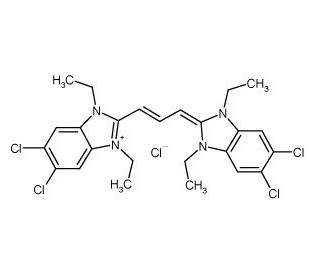

JC-1 chloride (CAS 3520-43-2 free base)
QUICK LINKS
JC-1 chloride is a very sensitive fluorescent probe for testing Pgp activity. Capable of distinguishing between resistant, intermediate and sensitve groups, whereas rhodamine 123 only recognizes the resistent group. In cell lines, the red emission band is more convenient for detection of low-level resistance in AML than other probes, such as rhodamine 123 (529nm) or calcein-AM (517nm). Green fluorescent JC-1 existing as a monomer (λem=527nm) at low concentrations or at low membrane potential. However, at higher concentrations (aqueous solutions above 0.1µM) or higher potentials, JC-1 forms red fluorescent ′J-aggregates′, which exhibit a broad excitation spectrum and a very narrow emission spectrum (λem=590nm). JC-1 stains mitochondria in living cells in a membrane potential-dependent function. JC-1 has been used in a functional assay of multidrug resistance cells and in apoptosis related mitochondrial modifications.
JC-1 chloride (CAS 3520-43-2 free base) References
Intracellular heterogeneity in mitochondrial membrane potentials revealed by a J-aggregate-forming lipophilic cation JC-1: S.T. Smiley, et al.; PNAS 88, 3671 (1991) J-aggregate formation of a carbocyanine as a quantitative fluorescent indicator of membrane potential: M. Reers, et al.; Biochemistry 30, 4480 (1991) A new method for the cytofluorimetric analysis of mitochondrial membrane potential using the J-aggregate forming lipophilic cation 5,5',6,6'-tetrachloro-1,1',3,3'-tetraethylbenzimidazolcarbocyanine iodide (JC-1): A. Cossarizza, et al.; BBRC 197, 40 (1993) Abstract Mitochondrial mass and membrane potential in coelomocytes from the earthworm Eisenia foetida: studies with fluorescent probes in single intact cells: A. Cossarizza, et al.; BBRC 214, 503 (1995) Mitochondrial membrane potential monitored by JC-1 dye: M. Reers, et al.; Methods Enzymol. 260, 406 (1995) Functional assay of multidrug resistant cells using JC-1, a carbocyanine fluorescent probe: J.M. Kühnel, et al.; Leukemia 11, 1147 (1997) Abstract JC-1, but not DiOC6(3) or rhodamine 123, is a reliable fluorescent probe to assess delta psi changes in intact cells: implications for studies on mitochondrial functionality during apoptosis: S. Salvioli, et al.; FEBS Lett. 411, 77 (1997) Mitochondria and apoptosis: D.R. Green & J.C. Reed; Science 281, 1309 (1998) Flow cytometric measurement of mitochondrial mass and function: a novel method for assessing chemoresistance: M. Mancini, et al.; Ann. Surg. Oncol. 5, 287 (1998) Flavonoid-related modulators of multidrug resistance: synthesis, pharmacological activity, and structure-activity relationships: J. Ferte, et al.; J. Med. Chem. 42, 478 (1999) UVA1 radiation triggers two different final apoptotic pathways: D.E. Godar; J. Invest. Dermatol. 112, 3 (1999) A rapid method for the evaluation of compounds with mitochondria-protective properties: R. Nuydens, et al.; J. Neurosci. Methods 92, 153 (1999) Abstract JC-1: a very sensitive fluorescent probe to test Pgp activity in adult acute myeloid leukemia: O. Legrand, et al.; Blood 97, 502 (2001) Abstract; Full Text Intra- and intercellular distribution of mitochondrial probes and changes after treatment with MDR modulators: G. Diaz, et al.; IUBMB Life 51, 121 (2001)Ordering Information
| Product Name | Catalog # | UNIT | Price | Qty | FAVORITES | |
JC-1 chloride, 5 mg | sc-221777 | 5 mg | $449.00 |