
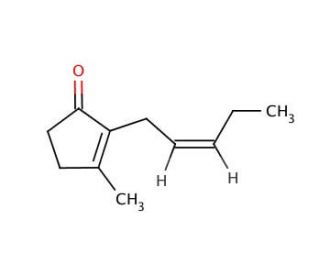

Jasmone (CAS 488-10-8)
QUICK LINKS
Jasmone is a vital aromatic compound found in various types of tea, including green tea, Oolong tea, jasmine tea, and Tie Guanyin tea. It also serves as the primary odor component in jasmine oil. In plants, jasmone plays a significant role as a defense activator when encountering insect attacks or mechanical damage. Chemically classified as a cyclic ketone, jasmone belongs to the class of organic compounds featuring a ketone group conjugated to a cyclic moiety. Specifically, jasmone is identified as an octadecanoid lipid molecule. It is characterized as practically insoluble in water and possesses a relatively neutral nature. Within cells, jasmone is predominantly found in the membrane, as determined by its predicted logP value. Jasmone imparts a celery-like, floral, and herbal taste and is present in several food items, such as orange mint, sweet orange, tea, as well as various herbs and spices. This characteristic makes jasmone a potential biomarker for identifying the consumption of these food products.
Jasmone (CAS 488-10-8) References
- New roles for cis-jasmone as an insect semiochemical and in plant defense. | Birkett, MA., et al. 2000. Proc Natl Acad Sci U S A. 97: 9329-34. PMID: 10900270
- cis-Jasmone treatment induces resistance in wheat plants against the grain aphid, Sitobion avenae (Fabricius) (Homoptera: Aphididae). | Bruce, TJ., et al. 2003. Pest Manag Sci. 59: 1031-6. PMID: 12974355
- cis-Jasmone induces accumulation of defence compounds in wheat, Triticum aestivum. | Moraes, MC., et al. 2008. Phytochemistry. 69: 9-17. PMID: 17681563
- Developments in aspects of ecological phytochemistry: the role of cis-jasmone in inducible defence systems in plants. | Pickett, JA., et al. 2007. Phytochemistry. 68: 2937-45. PMID: 18023830
- Attraction of New Zealand flower thrips, Thrips obscuratus, to cis-jasmone, a volatile identified from Japanese honeysuckle flowers. | El-Sayed, AM., et al. 2009. J Chem Ecol. 35: 656-63. PMID: 19444522
- Emerging roles in plant defense for cis-jasmone-induced cytochrome P450 CYP81D11. | Matthes, M., et al. 2011. Plant Signal Behav. 6: 563-5. PMID: 21422824
- Fragrance material review on cis-jasmone. | Scognamiglio, J., et al. 2012. Food Chem Toxicol. 50 Suppl 3: S613-8. PMID: 22445665
- cis-Jasmone Elicits Aphid-Induced Stress Signalling in Potatoes. | Sobhy, IS., et al. 2017. J Chem Ecol. 43: 39-52. PMID: 28130741
- Elucidation of the biosynthetic pathway of cis-jasmone in Lasiodiplodia theobromae. | Matsui, R., et al. 2017. Sci Rep. 7: 6688. PMID: 28751737
- Jasmone Hydroxylase, a Key Enzyme in the Synthesis of the Alcohol Moiety of Pyrethrin Insecticides. | Li, W., et al. 2018. Plant Physiol. 177: 1498-1509. PMID: 29967096
- An odorant receptor mediates the attractiveness of cis-jasmone to Campoletis chlorideae, the endoparasitoid of Helicoverpa armigera. | Sun, YL., et al. 2019. Insect Mol Biol. 28: 23-34. PMID: 30058747
- Effects of cis-Jasmone Treatment of Brassicas on Interactions With Myzus persicae Aphids and Their Parasitoid Diaeretiella rapae. | Ali, J., et al. 2021. Front Plant Sci. 12: 711896. PMID: 34659285
- Pharmacological Potential of cis-jasmone in Adult Zebrafish (Danio rerio). | Bezerra, FMDH., et al. 2023. Planta Med.. PMID: 36720229
- Mechanism of stimulation of the calcium adenosinetriphosphatase by jasmone. | Starling, AP., et al. 1994. Biochemistry. 33: 3023-31. PMID: 8130215
Ordering Information
| Product Name | Catalog # | UNIT | Price | Qty | FAVORITES | |
Jasmone, 1 ml | sc-250208 | 1 ml | $152.00 |