
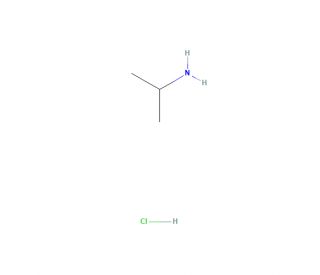

Isopropylamine Hydrochloride (CAS 15572-56-2)
QUICK LINKS
Isopropylamine Hydrochloride, often encountered as a hydrochloride salt, is a compound that plays a pivotal role in various fields of chemical research and industrial applications, primarily due to its basic nature and solubility in water. This compound is formed through the reaction of isopropylamine with hydrochloric acid, leading to a salt that is highly sought after for its use as a precursor in the synthesis of herbicides, pharmaceuticals, and other organic compounds. The mechanism of action of Isopropylamine Hydrochloride involves its ability to donate a proton (from the hydrochloride portion) and accept a proton (through the amine group), making it an excellent candidate for acid-base reactions in organic synthesis. This dual capability facilitates its role in the production of a wide range of chemical products, including as a catalyst or an intermediate in complex chemical reactions. Its role in research extends to being a key reagent in the development of new synthetic pathways, where its chemical properties are exploited to achieve specific reaction outcomes. This compound′s significance is underscored by its utility in enhancing reaction efficiencies, optimizing production processes, and developing novel materials and chemicals.
Isopropylamine Hydrochloride (CAS 15572-56-2) References
- The design and cytotoxic evaluation of some 1-aryl-3-isopropylamino-1-propanone hydrochlorides towards human Huh-7 hepatoma cells. | Mete, E., et al. 2011. Arch Pharm (Weinheim). 344: 333-9. PMID: 21319206
- In-Depth Compositional and Structural Characterization of N-Glycans Derived from Human Urinary Exosomes. | Song, W., et al. 2019. Anal Chem. 91: 13528-13537. PMID: 31539226
- α2,3 linkage of sialic acid to a GPI anchor and an unpredicted GPI attachment site in human prion protein. | Kobayashi, A., et al. 2020. J Biol Chem. 295: 7789-7798. PMID: 32321762
- Fractionation and characterization of sialyl linkage isomers of serum N-glycans by CE-MS. | Zhou, X., et al. 2022. J Sep Sci. 45: 3348-3361. PMID: 35819141
- Influenza A Virus Agnostic Receptor Tropism Revealed Using a Novel Biological System with Terminal Sialic Acid Knockout Cells. | Kamiki, H., et al. 2022. J Virol. 96: e0041622. PMID: 35862707
- Efficient Synthesis of Key Chiral Intermediate in Painkillers (R)-1-[3,5-Bis(trifluoromethyl)phenyl]ethanamine by Bienzyme Cascade System with R-ω-Transaminase and Alcohol Dehydrogenase Functions. | Lu, Y., et al. 2022. Molecules. 27: PMID: 36364166
- The Quality and Bacterial Community Changes in Freshwater Crawfish Stored at 4 °C in Vacuum Packaging. | Qiu, L., et al. 2022. Molecules. 27: PMID: 36500719
- Photo-on-Demand In Situ Synthesis of N-Substituted Trichloroacetamides with Tetrachloroethylene and Their Conversions to Ureas, Carbamates, and Polyurethanes. | Akamatsu, T., et al. 2023. ACS Omega. 8: 2669-2684. PMID: 36687089
Ordering Information
| Product Name | Catalog # | UNIT | Price | Qty | FAVORITES | |
Isopropylamine Hydrochloride, 25 g | sc-484727 | 25 g | $63.00 |