
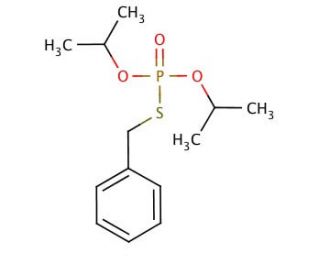

Molekülstruktur von Iprobenfos, CAS-Nummer: 26087-47-8
Iprobenfos (CAS 26087-47-8)
Alternative Namen:
S-Benzyl-O,O-di-isopropyl phosphorothioate
CAS Nummer:
26087-47-8
Molekulargewicht:
288.34
Summenformel:
C13H21O3PS
Ergänzende Informationen:
Dieses Produkt wird als Gefahrgut eingestuft und unterliegt möglicherweise zusätzlichen Versandkosten.
Ausschließlich für Forschungszwecke. Nicht Geeignet für Verwendung in Diagnostik oder Therapie.
* Schauen Sie auf das Analysezertifikat (CoA), um die genauen Daten (inkl. Wassergehalt) Ihrer Produktionscharge (Lot) zu sehen.
Direktverknüpfungen
Bestellinformation
Beschreibung
Hintergrundinformationen
Sicherheitshinweis
SDS (SDB) & Analysenzertifikate
Iprobenfos ist eine chemische Verbindung, die als systemisches Fungizid wirkt. Sein Wirkmechanismus besteht in der Hemmung der Biosynthese von Methionin in Pilzen. Indem es auf das Enzym S-Adenosyl-L-Methionin-Synthetase abzielt, unterbricht Iprobenfos die Produktion von Methionin, was zu einer Hemmung des Pilzwachstums und der Reproduktion führt. Auf molekularer Ebene greift Iprobenfos in die normale Funktionsweise von Pilzzellen ein, stört ihre Fähigkeit, Proteine zu synthetisieren, und führt schließlich zu ihrem Absterben.
Iprobenfos (CAS 26087-47-8) Literaturhinweise
- Fenpyroximat-Resistenz bei Tetranychus urticae (Acari: Tetranychidae): Kreuzresistenz und biochemische Resistenzmechanismen. | Kim, YJ., et al. 2004. Pest Manag Sci. 60: 1001-6. PMID: 15481826
- Wirkung einer Mischung aus Iprobenfos und Malathion auf die Entwicklung einer Malathion-Resistenz bei der Stechmücke Culex pipiens pallens Coq. | Tao, LM., et al. 2006. Pest Manag Sci. 62: 86-90. PMID: 16235270
- Charakterisierung von Cholinesterasen in der Marmorierten Seezunge, Limanda yokohamae, und ihre Hemmung in vitro durch das Fungizid Iprobenfos. | Jung, JH., et al. 2007. Mar Environ Res. 63: 471-8. PMID: 17300836
- Die Nützlichkeit eines künstlichen Membranakkumulationsindexes für die Schätzung des Biokonzentrationsfaktors von Organophosphorpestiziden. | Fujikawa, M., et al. 2009. Chemosphere. 74: 751-7. PMID: 19084258
- Entwicklung und Validierung einer Multiresiduen-Methode zur Bestimmung von 82 Pestiziden in Wasser mittels GC. | Mamun, MI., et al. 2009. J Sep Sci. 32: 559-74. PMID: 19212978
- Pestizidrückstände in Küstengewässern, die von Reisfeldabwässern betroffen sind, die vorübergehend in einem Abwasserreservoir in Südjapan gelagert wurden. | Añasco, NC., et al. 2010. Arch Environ Contam Toxicol. 58: 352-60. PMID: 19609592
- Veränderungen der Konzentrationen, Verbringungsmengen und ökologischen Risiken von Pestiziden in Flusswasser, das in den Biwa-See fließt. | Tsuda, T., et al. 2011. Bull Environ Contam Toxicol. 87: 307-11. PMID: 21674152
- Einfacher und empfindlicher Nachweis von Organophosphor-Chemikalien durch schnelle Aggregation von Gold-Nanopartikeln mit organischen Verbindungen. | Kim, MS., et al. 2015. Biosens Bioelectron. 67: 408-12. PMID: 25216978
- Isolierung und Charakterisierung des ABC-Transporters CaABC1 von Colletotrichum acutatum. | Kim, S., et al. 2014. Plant Pathol J. 30: 375-83. PMID: 25506302
- Nachweis von Iprobenfos und Edifenphos mit einem neuen Multiapparat-Sensor. | Kwon, YS., et al. 2015. Anal Chim Acta. 868: 60-6. PMID: 25813235
- Ein mutmaßlicher Zn2Cys6-Transkriptionsfaktor ist mit der Isoprothiolan-Resistenz von Magnaporthe oryzae verbunden. | Wang, ZQ., et al. 2018. Front Microbiol. 9: 2608. PMID: 30429837
- Verschmutzungsgrad von verbotenen und nicht verbotenen Pestiziden in Oberflächensedimenten aus dem Ostchinesischen Meer. | Lan, J., et al. 2019. Mar Pollut Bull. 139: 332-338. PMID: 30686435
- Studio di approccio per il bilancio di massa dei residui di pesticidi negli scarti di distillazione insieme al distillato e verifica dell'assenza di pesticidi nelle acquaviti distillate da una colonna di distillazione su scala pilota. | Shin, JA., et al. 2019. Molecules. 24: PMID: 31311184
- Rückstände von Pestiziden und ihre Toxizität für Süßwassergarnelen in der litoralen und pelagischen Zone des Kasumigaura-Sees, Japan. | Nohara, S. and Iwakuma, T. 1996. Chemosphere. 33: 1417-24. PMID: 8799998
Bestellinformation
| Produkt | Katalog # | EINHEIT | Preis | ANZAHL | Favoriten | |
Iprobenfos, 100 mg | sc-250165 | 100 mg | $163.00 |