
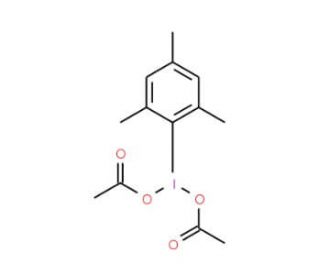

Iodomesitylene Diacetate (CAS 33035-41-5)
LINK RAPIDI
Lo iodomesitilene diacetato, comunemente chiamato TDI, riveste un ruolo importante nelle applicazioni della ricerca scientifica. Lo iodomesitilene diacetato funge da intermedio cruciale nella sintesi di vari composti e ha trovato ampio utilizzo come reagente nella produzione di prodotti agrochimici e coloranti. Le applicazioni dello iodomesitilene diacetato nella ricerca scientifica sono diverse e abbracciano vari settori. Inoltre, lo iodomesilene diacetato ha svolto un ruolo cruciale nella sintesi dei polimeri, contribuendo in particolare alla formazione di poliuretani e poliesteri. Inoltre, le sue proprietà catalitiche sono state sfruttate nella sintesi di composti eterociclici. Lo iodomesitilene diacetato funziona come reagente elettrofilo nella sintesi di vari composti. Si aggancia facilmente a nucleofili come alcoli, ammine e acidi carbossilici, avviando una reazione che culmina nella formazione di un prodotto. Il processo inizia con la generazione di un carbocatione, che successivamente subisce una reazione con il nucleofilo per ottenere il prodotto desiderato.
Iodomesitylene Diacetate (CAS 33035-41-5) Referenze
- Notevole reattività dei catalizzatori Pd(OAc)2/piridina: ossigenazione C-H non diretta di arene. | Emmert, MH., et al. 2011. Angew Chem Int Ed Engl. 50: 9409-12. PMID: 21948437
- Sintesi mediata da basi di eteri alchilici dalla reazione di alcoli alifatici e sali di diarilodonio asimmetrici. | Sundalam, SK. and Stuart, DR. 2015. J Org Chem. 80: 6456-66. PMID: 26020831
- Arilazione con sali di diarilodonio. | Olofsson, B. 2015. Top Curr Chem.. PMID: 26499897
- Sali di aril(2,4,6-trimetossifenil)iodonio asimmetrici: Sintesi one-pot, campo di applicazione, stabilità e studi sintetici. | Seidl, TL., et al. 2016. J Org Chem. 81: 1998-2009. PMID: 26828570
- Accoppiamento decarbossilativo sp3 C-N attraverso una doppia catalisi di rame e fotoredox. | Liang, Y., et al. 2018. Nature. 559: 83-88. PMID: 29925943
- Studio meccanicistico sul cross-coupling sp3 C-N decarbossilativo tra acidi carbossilici alchilici e nucleofili azotati mediante catalisi duale di rame e fotoredox. | Zhao, X., et al. 2019. Inorg Chem. 58: 12669-12677. PMID: 31498616
- Effetto del backbone del ligando sulla reattività e sul paradigma meccanicistico del ferro(IV)-Oxo non eme durante l'epossidazione delle olefine. | Biswas, JP., et al. 2021. Angew Chem Int Ed Engl. 60: 14030-14039. PMID: 33836110
- Metallaphotoredox: la fusione tra fotoredox e catalisi dei metalli di transizione. | Chan, AY., et al. 2022. Chem Rev. 122: 1485-1542. PMID: 34793128
- Accoppiamenti di frammenti non tradizionali di alcoli e acidi carbossilici: accoppiamento incrociato C(sp3)-C(sp3) tramite ordinamento radicale. | Sakai, HA. and MacMillan, DWC. 2022. J Am Chem Soc. 144: 6185-6192. PMID: 35353531
- Recenti sviluppi nelle reazioni di cross-coupling decarbossilativo tra acidi carbossilici e composti N-H. | Arshadi, S., et al. 2019. RSC Adv. 9: 8964-8976. PMID: 35517670
- Catalisi del nichel tramite sostituzione omolitica SH2: Il doppio accoppiamento incrociato decarbossilativo degli acidi alifatici. | Tsymbal, AV., et al. 2022. J Am Chem Soc. 144: 21278-21286. PMID: 36375080
Informazioni ordini
| Nome del prodotto | Codice del prodotto | UNITÀ | Prezzo | Quantità | Preferiti | |
Iodomesitylene Diacetate, 5 g | sc-295187 | 5 g | $213.00 | |||
Iodomesitylene Diacetate, 10 g | sc-295187A | 10 g | $379.00 |