
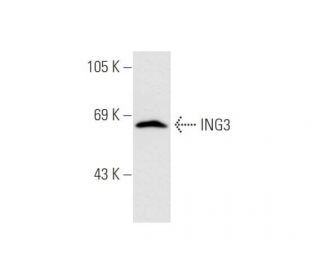


ING3 Antibody (162.1): sc-101245
- ING3 Antibody (162.1) is a mouse monoclonal IgG2b κ ING3 antibody, cited in 1 publications, provided at 100 µg/ml
- raised against recombinant ING3 of human origin
- recommended for detection of ING3 of mouse, rat and human origin by WB, IP, IF and ELISA
- At present, we have not yet completed the identification of the preferred secondary detection reagent(s) for ING3 Antibody (162.1). This work is in progress.

ING3 Antibody (162.1) is a mouse monoclonal IgG2b kappa light chain antibody that detects ING3 protein of mouse, rat, and human origin by western blotting (WB), immunoprecipitation (IP), immunofluorescence (IF), and enzyme-linked immunosorbent assay (ELISA). Anti-ING3 antibody (162.1) is available as the non-conjugated format. ING3 is a crucial nuclear tumor-suppressor that plays a significant role in regulating cellular responses to stress, particularly in UV-induced damage. ING3 activates apoptosis through a FAS-mediated pathway, which is vital for eliminating damaged cells and preventing cancer development. ING3 is involved in p53-mediated transcription and apoptosis, functioning as a component of the NuA4 complex histone acetyltransferase complex. This interaction modifies chromatin structure and facilitates transcription of genes involved in cell cycle regulation and apoptosis. Overexpression of ING3 has been linked to increased cleavage of apoptosis-related caspases and BID, although this occurs through a mechanism that doesn′t involve mitochondrial protein upregulation. Defects in ING3 can lead to impaired UV-induced apoptosis, which significantly influences the prognosis of melanomas and head and neck cancers, highlighting ING3′s importance in cancer biology and therapeutic strategies.
Alexa Fluor® is a trademark of Molecular Probes Inc., OR., USA
LI-COR® and Odyssey® are registered trademarks of LI-COR Biosciences
ING3 Antibody (162.1) References:
- Allelic loss and reduced expression of the ING3, a candidate tumor suppressor gene at 7q31, in human head and neck cancers. | Gunduz, M., et al. 2002. Oncogene. 21: 4462-70. PMID: 12080476
- A novel PHD-finger motif protein, p47ING3, modulates p53-mediated transcription, cell cycle control, and apoptosis. | Nagashima, M., et al. 2003. Oncogene. 22: 343-50. PMID: 12545155
- Structural and functional conservation of the NuA4 histone acetyltransferase complex from yeast to humans. | Doyon, Y., et al. 2004. Mol Cell Biol. 24: 1884-96. PMID: 14966270
- Frequent deletion and down-regulation of ING4, a candidate tumor suppressor gene at 12p13, in head and neck squamous cell carcinomas. | Gunduz, M., et al. 2005. Gene. 356: 109-17. PMID: 15935570
- ING tumor suppressor proteins are critical regulators of chromatin acetylation required for genome expression and perpetuation. | Doyon, Y., et al. 2006. Mol Cell. 21: 51-64. PMID: 16387653
- ING3 promotes UV-induced apoptosis via Fas/caspase-8 pathway in melanoma cells. | Wang, Y. and Li, G. 2006. J Biol Chem. 281: 11887-93. PMID: 16520380
- Prognostic significance of nuclear ING3 expression in human cutaneous melanoma. | Wang, Y., et al. 2007. Clin Cancer Res. 13: 4111-6. PMID: 17634537
- Downregulation of ING3 mRNA expression predicts poor prognosis in head and neck cancer. | Gunduz, M., et al. 2008. Cancer Sci. 99: 531-8. PMID: 18081876
Ordering Information
| Product Name | Catalog # | UNIT | Price | Qty | FAVORITES | |
ING3 Antibody (162.1) | sc-101245 | 100 µg/ml | $339.00 |