
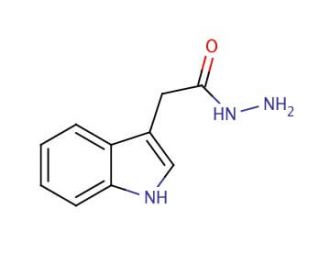

Indole-3-acetic hydrazide (CAS 5448-47-5)
QUICK LINKS
Indole-3-acetic hydrazide is a chemical derivative of indole-3-acetic acid (IAA), which is a naturally occurring auxin, a class of plant hormones essential for growth and development. Structurally, this compound features the indole ring typical of IAA but is modified by the substitution of a hydrazide group (-CO-NHNH2) at the position where the acetic acid group would normally be found. This modification significantly alters the compound′s biological activity and chemical properties. In research, indole-3-acetic hydrazide has been utilized primarily to study its interaction with plant physiological processes compared to IAA. It acts as an auxin antagonist in many cases, used to dissect the role of natural auxins in plant tissue culture experiments. The presence of the hydrazide group can affect the uptake, metabolism, and transport of the molecule within plant systems, offering insights into the detailed mechanisms of hormone action and regulation. Additionally, this chemical has been used in synthetic chemistry to explore the stability, reactivity, and potential applications of hydrazide compounds. Through these applications, indole-3-acetic hydrazide serves as a tool in both plant biology and synthetic organic chemistry, facilitating a deeper understanding of hormone-related plant developmental processes and expanding the chemistry of indole derivatives.
Indole-3-acetic hydrazide (CAS 5448-47-5) References
- A fluorescent analogue of UDP-N-acetylglucosamine: application for FRET assay of peptidoglycan translocase II (MurG). | Li, JJ. and Bugg, TD. 2004. Chem Commun (Camb). 182-3. PMID: 14737539
- 2-(1H-Indol-3-yl)acetohydrazide. | Sidra, LR., et al. 2012. Acta Crystallogr Sect E Struct Rep Online. 68: o3140-1. PMID: 23284462
- pH-Triggered Controllable Release of Silver-Indole-3 Acetic Acid Complexes from Mesoporous Silica Nanoparticles (IBN-4) for Effectively Killing Malignant Bacteria. | Kuthati, Y., et al. 2015. Mol Pharm. 12: 2289-304. PMID: 25996616
- Synthesis, pharmacological screening and computational analysis of some 2-(1H-Indol-3-yl)-N'-[(un)substituted phenylmethylidene] acetohydrazides and 2-(1H-Indol-3-yl)-N'-[(un)substituted benzoyl/2-thienylcarbonyl]acetohydrazides. | Rubab, K., et al. 2017. Pak J Pharm Sci. 30: 1263-1274. PMID: 29039324
- Optimizing the flavanone core toward new selective nitrogen-containing modulators of ABC transporters. | Ferreira, RJ., et al. 2018. Future Med Chem. 10: 725-741. PMID: 29570361
- In Vitro and In Silico Evaluation of Anticancer Activity of New Indole-Based 1,3,4-Oxadiazoles as EGFR and COX-2 Inhibitors. | Sever, B., et al. 2020. Molecules. 25: PMID: 33171861
- Discovery of pyrazole-carbohydrazide with indole moiety as tubulin polymerization inhibitors and anti-tumor candidates. | Man, RJ., et al. 2023. Drug Dev Res. 84: 110-120. PMID: 36433708
- A Bird's Eye Review of Recent Reports on 1,3,4-oxadiazoles' Anti-inflammatory Insights Perspectives. | Chaudhary, T. and Upadhyay, PK. 2024. Curr Org Synth. 21: 595-606. PMID: 37157211
- Synthesis and Molecular Docking Studies of Novel Biheterocyclic Propanamides as Antidiabetic Agents Having Mild Cytotoxicity. | Abbasi, MA., et al. 2023. ACS Omega. 8: 22899-22911. PMID: 37396264
- Mechanochemical Studies on Coupling of Hydrazines and Hydrazine Amides with Phenolic and Furanyl Aldehydes-Hydrazones with Antileishmanial and Antibacterial Activities. | Kapusterynska, A., et al. 2023. Molecules. 28: PMID: 37446945
Ordering Information
| Product Name | Catalog # | UNIT | Price | Qty | FAVORITES | |
Indole-3-acetic hydrazide, 1 g | sc-257607 | 1 g | $66.00 |