
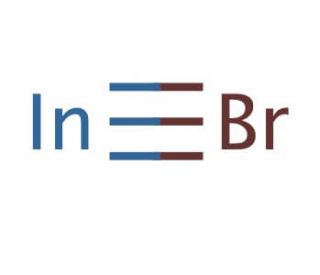

Indium(I) bromide (CAS 14280-53-6)
QUICK LINKS
Indium(I) bromide is widely used in research primarily focused on material science and organic synthesis. This compound is valuable for its role in the synthesis of complex organic molecules, acting as a catalyst or reagent that facilitates various chemical transformations. Researchers utilize Indium(I) bromide to study its effectiveness in promoting allylation reactions, which are for forming carbon-carbon bonds in organic compounds. Additionally, it is employed in the deposition processes of thin films for electronic and photonic devices, where its properties help in the development of indium-containing layers. The research involving Indium(I) bromide significantly advances the understanding of its chemical behavior and potential applications in creating advanced materials and chemicals.
Indium(I) bromide (CAS 14280-53-6) References
- Reactions of Elemental Indium and Indium(I) Bromide with Nickel-Bromine Bonds: Structure of (eta(5)-C(5)H(5))(Ph(3)P)Ni-InBr(2)(O=PPh(3)). | Weiss, J., et al. 1996. Inorg Chem. 35: 71-75. PMID: 11666166
- A new route to 2-C- and 4-C-branched sugars by palladium-indium bromide-mediated carbonyl allylation. | Norsikian, S. and Lubineau, A. 2005. Org Biomol Chem. 3: 4089-94. PMID: 16267588
- Ruthenium(III)-catalysed phenylselenylation of allyl acetates by diphenyl diselenide and indium(I) bromide in neat: isolation and identification of intermediate. | Saha, A. and Ranu, BC. 2011. Org Biomol Chem. 9: 1763-7. PMID: 21258726
- Reactions of Elemental Indium and Indium(I) Bromide with Nickel−Bromine Bonds: Structure of (η5-C5H5)(Ph3P)NiInBr2(OPPh3)† | Jurij Weiss, Thomas Priermeier, and Roland A. Fischer. 1996. Inorg. Chem., 35, 1,: 71–75.
- Indium(I) bromide-mediated coupling of dibromoacetonitrile with aldehydes followed by Boord elimination of bromine and oxygen of β-bromo alkoxides for preparation of 3-organyl-2-alkenenitriles | Clovis Peppe, Paola de Azevedo Mello, Rafael Pavão das Chagas. 15 May 2006,. Journal of Organometallic Chemistry. Volume 691, Issue 11,: Pages 2335-2339.
- Indium(I) bromide-promoted stereoselective preparation of cyclopropanes via sequential aldol-type coupling/elimination/Michael-induced ring closure reaction from α,α-dichloroacetophenone and aldehydes | Clovis Peppe, Rafael Pavão das Chagas, Robert Alan Burrow. 15 October 2008,. Journal of Organometallic Chemistry. Volume 693, Issues 21–22,: Pages 3441-3445.
- Indium (I) bromide-mediated dichlorocyanomethylation of carbonyl compounds. The preparation of 2, 2-dichloro-3-hydroxynitriles | J.A Nóbrega a, Simone M.C Gonçalves a, C Peppe b. 16 July 2001,. Tetrahedron Letters. Volume 42, Issue 29,: Pages 4745-4746.
- The high temperature heat capacities of indium(i) bromide and indium(III) bromide by differential scanning calorimetry | Peter J. Gardner, Steve R. Preston. 26 April 1991,. Thermochimica Acta. Volume 180,: Pages 281-287.
Ordering Information
| Product Name | Catalog # | UNIT | Price | Qty | FAVORITES | |
Indium(I) bromide, 5 g | sc-257603 | 5 g | $212.00 |