
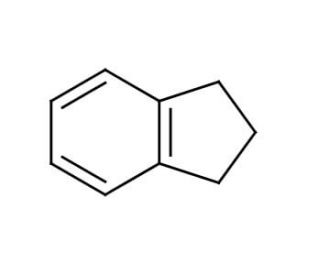

Molecular structure of Indan, CAS Number: 496-11-7
Indan (CAS 496-11-7)
Alternate Names:
Hydrindene
CAS Number:
496-11-7
Molecular Weight:
118.18
Molecular Formula:
C9H10
Supplemental Information:
This is classified as a Dangerous Good for transport and may be subject to additional shipping charges.
For Research Use Only. Not Intended for Diagnostic or Therapeutic Use.
* Refer to Certificate of Analysis for lot specific data.
QUICK LINKS
Ordering Information
Description
Technical Information
Safety Information
SDS & Certificate of Analysis
Indan is utilized in research environments where its properties as a hydrocarbon scaffold are of interest. Indan is explored particularly for its role in the synthesis of bioactive compounds and fine chemicals, where it acts as a versatile building block. Indan is investigated in materials science, especially in the study of polymers and resins, where its incorporation can affect the thermal and mechanical properties of the materials. Its application in the development of new synthesis routes for aromatic compounds further underscores its importance in advancing chemical synthesis techniques.
Indan (CAS 496-11-7) References
- One enzyme, many reactions: structural basis for the various reactions catalyzed by naphthalene 1,2-dioxygenase. | Ferraro, DJ., et al. 2017. IUCrJ. 4: 648-656. PMID: 28989720
- Cobalt-Catalyzed Stereoretentive Hydrogen Isotope Exchange of C(sp3)-H Bonds. | Palmer, WN. and Chirik, PJ. 2017. ACS Catal. 7: 5674-5678. PMID: 29456876
- Transformation Characteristics of Hydrogen-Donor Solvent Tetralin in the Process of Direct Coal Liquefaction. | Chang, HZ., et al. 2019. Front Chem. 7: 737. PMID: 31737609
- Electrochemical oxidation-induced etherification via C(sp3)─H/O─H cross-coupling. | Wang, H., et al. 2020. Sci Adv. 6: eaaz0590. PMID: 32440542
- GC-MS hydrocarbon degradation profile data of Pseudomonas frederiksbergensis SI8, a bacterium capable of degrading aromatics at low temperatures. | Ruiz, ON., et al. 2021. Data Brief. 35: 106864. PMID: 33665259
- Effects of Molecular Properties on Adsorption of Six-Carbon VOCs by Activated Carbon in a Fixed Adsorber. | Huang, SC., et al. 2021. ACS Omega. 6: 5825-5835. PMID: 33681621
- Controlling Nanostructure in Inkjet Printed Organic Transistors for Pressure Sensing Applications. | Griffith, MJ., et al. 2021. Nanomaterials (Basel). 11: PMID: 33946256
- Computational Redesign of an ω-Transaminase from Pseudomonas jessenii for Asymmetric Synthesis of Enantiopure Bulky Amines. | Meng, Q., et al. 2021. ACS Catal. 11: 10733-10747. PMID: 34504735
- Computational Prediction of ω-Transaminase Specificity by a Combination of Docking and Molecular Dynamics Simulations. | Ramírez-Palacios, C., et al. 2021. J Chem Inf Model. 61: 5569-5580. PMID: 34653331
- The LAM of the Rings: Large Amplitude Motions in Aromatic Molecules Studied by Microwave Spectroscopy. | Nguyen, HVL., et al. 2022. Molecules. 27: PMID: 35745072
- Structure of the active Gi-coupled human lysophosphatidic acid receptor 1 complexed with a potent agonist. | Akasaka, H., et al. 2022. Nat Commun. 13: 5417. PMID: 36109516
- Chemical Structures, Properties, and Applications of Selected Crude Oil-Based and Bio-Based Polymers. | Koczoń, P., et al. 2022. Polymers (Basel). 14: PMID: 36559918
- Dealkylation in Fluid Catalytic Cracking Condition for Efficient Conversion of Heavy Aromatics to Benzene-Toluene-Xylene. | Wang, D., et al. 2023. ACS Omega. 8: 10789-10795. PMID: 37008116
Ordering Information
| Product Name | Catalog # | UNIT | Price | Qty | FAVORITES | |
Indan, 250 mg | sc-250151 | 250 mg | $44.00 |