
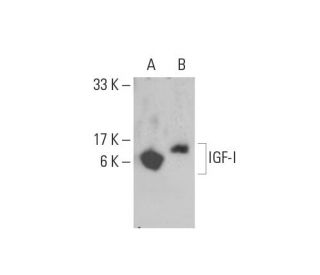

IGF-I Antibody (E-3): sc-518063
- IGF-I Antibody (E-3) is a mouse monoclonal IgM κ provided at 200 µg/ml
- specific for an epitope mapping between amino acids 72-98 within an internal region of IGF-I of human origin
- recommended for detection of IGF-I of human origin by WB, IP, IF and ELISA
- m-IgGκ BP-HRP is the preferred secondary detection reagent for IGF-I Antibody (E-3) for WB applications. This reagent is now offered in a bundle with IGF-I Antibody (E-3) (see ordering information below). For additional m-IgGκ BP conjugates see our complete list of Mouse IgG Binding Proteins.

QUICK LINKS
SEE ALSO...
IGF-I Antibody (E-3) is a mouse monoclonal IgM κ antibody that detects insulin-like growth factor I (IGF-I) in human samples through applications such as western blotting (WB), immunoprecipitation (IP), immunofluorescence (IF), and enzyme-linked immunosorbent assay (ELISA). IGF-I is a crucial peptide that plays a significant role in various physiological processes, including the stimulation of vascular smooth muscle cell growth and the regulation of renal function, growth, and tissue repair. Notably, IGF-I is also essential for bone formation and resorption, highlighting its importance in maintaining skeletal health. The activity of IGF-I is intricately modulated by a family of six circulating IGF-binding proteins (IGFBP1-6), which help regulate its availability and biological effects. Furthermore, IGF-I interacts with IGF-IR receptor, which is structurally similar to the insulin receptor, consisting of two extracellular alpha chains and two beta chains that are linked by disulfide bonds. This receptor interaction is vital for mediating the diverse biological effects of IGF-I, including influence on immune response and metabolic processes. Anti-IGF-I antibody (E-3) is an invaluable tool for researchers studying the multifaceted roles of IGF-I in health and disease.
Alexa Fluor® is a trademark of Molecular Probes Inc., OR., USA
LI-COR® and Odyssey® are registered trademarks of LI-COR Biosciences
IGF-I Antibody (E-3) References:
- Hypertrophy of cultured adult rat ventricular cardiomyocytes induced by antibodies against the insulin-like growth factor (IGF)-I or the IGF-I receptor is IGF-II-dependent. | Huang, CY., et al. 2002. Mol Cell Biochem. 233: 65-72. PMID: 12083381
- IGF-I and insulin activate mitogen-activated protein kinase via the type 1 IGF receptor in mouse embryonic stem cells. | Nguyen, TT., et al. 2007. Reproduction. 134: 41-9. PMID: 17641087
- Detection and downregulation of type I IGF receptor expression by antibody-conjugated quantum dots in breast cancer cells. | Zhang, H., et al. 2009. Breast Cancer Res Treat. 114: 277-85. PMID: 18418709
- Attenuation of IGF-I receptor signaling inhibits serum-induced proliferation of prostate cancer cells. | Himpe, E., et al. 2011. Growth Horm IGF Res. 21: 252-9. PMID: 21820343
- Insulin-like growth factor I (IGF-I) stimulates regeneration of the rat sciatic nerve. | Kanje, M., et al. 1989. Brain Res. 486: 396-8. PMID: 2731041
- Up-regulation of IGF-1, RANTES and VEGF in patients with anti-centromere antibody-positive early/mild systemic sclerosis. | Tabata, K., et al. 2021. Mod Rheumatol. 31: 171-176. PMID: 32013651
- Degradation of IGF-I in the adult rat gastrointestinal tract is limited by a specific antiserum or the dietary protein casein. | Xian, CJ., et al. 1995. J Endocrinol. 146: 215-25. PMID: 7561632
- IGF-1 influences olfactory bulb maturation. Evidence from anti-IGF-1 antibody treatment of developing grafts in oculo. | Giacobini, MM., et al. 1995. Brain Res Dev Brain Res. 84: 67-76. PMID: 7720219
- Insulin-like growth factor-I (IGF-I) production by astroglial cells: regulation and importance for epidermal growth factor-induced cell replication. | Chernausek, SD. 1993. J Neurosci Res. 34: 189-97. PMID: 8450562
- Insulin-like growth factor I (IGF-I) receptor overexpression abolishes the IGF requirement for differentiation and induces a ligand-dependent transformed phenotype in C2 inducible myoblasts. | Navarro, M., et al. 1997. Endocrinology. 138: 5210-9. PMID: 9389503
Ordering Information
| Product Name | Catalog # | UNIT | Price | Qty | FAVORITES | |
IGF-I Antibody (E-3) | sc-518063 | 200 µg/ml | $322.00 | |||
IGF-I Antibody (E-3): m-IgGκ BP-HRP Bundle | sc-552767 | 200 µg Ab; 40 µg BP | $361.00 |