
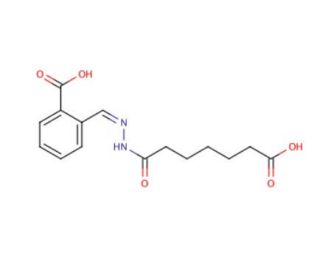

IDE 1 (CAS 1160927-48-9)
QUICK LINKS
IDE-1, a synthetic compound, has garnered significant attention in scientific research due to its role as a potent activator of the Hedgehog (Hh) signaling pathway. By targeting the smoothened (SMO) receptor, IDE-1 modulates Hh pathway activity, influencing cellular processes such as proliferation, differentiation, and tissue patterning. Its mechanism of action involves binding to the transmembrane protein SMO, leading to conformational changes that activate downstream signaling cascades, including the Gli family of transcription factors. IDE-1′s ability to activate the Hh pathway has been instrumental in elucidating its role in embryonic development, tissue regeneration, and stem cell maintenance. Research employing IDE-1 has provided insights into the molecular mechanisms underlying Hh pathway regulation and its implications in various developmental processes. Additionally, IDE-1 has been utilized in preclinical studies to investigate its potential applications in conditions characterized by dysregulated Hh signaling, such as certain cancers and developmental disorders. Furthermore, IDE-1 serves as a valuable tool in probing the signaling networks involved in embryogenesis and tissue homeostasis, contributing to a deeper understanding of cellular signaling dynamics and offering potential targets for further research endeavors.
IDE 1 (CAS 1160927-48-9) References
- Identification of novel cis-acting elements, IDE1 and IDE2, of the barley IDS2 gene promoter conferring iron-deficiency-inducible, root-specific expression in heterogeneous tobacco plants. | Kobayashi, T., et al. 2003. Plant J. 36: 780-93. PMID: 14675444
- Small molecules efficiently direct endodermal differentiation of mouse and human embryonic stem cells. | Borowiak, M., et al. 2009. Cell Stem Cell. 4: 348-58. PMID: 19341624
- Using small molecules to great effect in stem cell differentiation. | Zaret, KS. 2009. Cell Stem Cell. 4: 373-4. PMID: 19427285
- Stimulation of Activin A/Nodal signaling is insufficient to induce definitive endoderm formation of cord blood-derived unrestricted somatic stem cells. | Filby, CE., et al. 2011. Stem Cell Res Ther. 2: 16. PMID: 21463501
- Definitive endoderm differentiation of human-induced pluripotent stem cells using signaling molecules and IDE1 in three-dimensional polymer scaffold. | Hoveizi, E., et al. 2014. J Biomed Mater Res A. 102: 4027-36. PMID: 24277503
- Efficient programming of human eye conjunctiva-derived induced pluripotent stem (ECiPS) cells into definitive endoderm-like cells. | Massumi, M., et al. 2014. Exp Cell Res. 322: 51-61. PMID: 24434355
- Efficient derivation of retinal pigment epithelium cells from stem cells. | Westenskow, P., et al. 2015. J Vis Exp.. PMID: 25867641
- Differences in definitive endoderm induction approaches using growth factors and small molecules. | Bogacheva, MS., et al. 2018. J Cell Physiol. 233: 3578-3589. PMID: 29044512
- Mini-Review; Deriving Avian Stem Cells by Small Molecules. | Farzaneh, M. 2021. Curr Stem Cell Res Ther. 16: 238-242. PMID: 32867659
- The constitutively active pSMAD2/3 relatively improves the proliferation of chicken primordial germ cells. | Zare, M., et al. 2023. Mol Reprod Dev. 90: 339-357. PMID: 37379342
Ordering Information
| Product Name | Catalog # | UNIT | Price | Qty | FAVORITES | |
IDE 1, 10 mg | sc-363282 | 10 mg | $213.00 | |||
IDE 1, 50 mg | sc-363282A | 50 mg | $944.00 |