
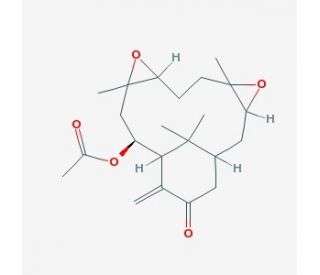

Molecular structure of Hypoestoxide, Hypoestes rosea, CAS Number: 88498-46-8
Hypoestoxide, Hypoestes rosea (CAS 88498-46-8)
Application:
Hypoestoxide, Hypoestes rosea is a naturally occurring, cell-permeable diterpene
CAS Number:
88498-46-8
Molecular Weight:
376.49
Molecular Formula:
C22H32O5
For Research Use Only. Not Intended for Diagnostic or Therapeutic Use.
* Refer to Certificate of Analysis for lot specific data.
QUICK LINKS
Ordering Information
Description
Technical Information
Safety Information
SDS & Certificate of Analysis
Hypoestoxide, Hypoestes rosea is a naturally occurring, cell-permeable diterpene with anti-inflammatory properties. Hypoestoxide, Hypoestes rosea is a selective and direct IKK (IkappaB kinase) inhibitor in TNF-alpha stimulated HeLa cells, which prevents NF-kappaB activation. Hypoestoxide, Hypoestes rosea also inhibits the nitric oxide production by IL-1beta or IL-17 stimulated chondrocytes.
Hypoestoxide, Hypoestes rosea (CAS 88498-46-8) References
- Hypoestoxide, a novel anti-inflammatory natural diterpene, inhibits the activity of IkappaB kinase. | Ojo-Amaize, EA., et al. 2001. Cell Immunol. 209: 149-57. PMID: 11446747
- Hypoestoxide, a natural nonmutagenic diterpenoid with antiangiogenic and antitumor activity: possible mechanisms of action. | Ojo-Amaize, EA., et al. 2002. Cancer Res. 62: 4007-14. PMID: 12124334
- NF-kappa B mediates the stimulation of cytokine and chemokine expression by human articular chondrocytes in response to fibronectin fragments. | Pulai, JI., et al. 2005. J Immunol. 174: 5781-8. PMID: 15843581
- Plasmodium berghei: antiparasitic effects of orally administered hypoestoxide in mice. | Ojo-Amaize, EA., et al. 2007. Exp Parasitol. 117: 218-21. PMID: 17568581
- Hypoestoxide inhibits tumor growth in the mouse CT26 colon tumor model. | Ojo-Amaize, EA., et al. 2007. World J Gastroenterol. 13: 4586-8. PMID: 17729410
- Topically applied diterpenoids from Egletes viscosa (Asteraceae) attenuate the dermal inflammation in mouse ear induced by tetradecanoylphorbol 13-acetate- and oxazolone. | Calou, IB., et al. 2008. Biol Pharm Bull. 31: 1511-6. PMID: 18670081
- An efficient substrate-controlled approach towards hypoestoxide, a member of a family of diterpenoid natural products with an inside-out [9.3.1]bicyclic core. | McGrath, NA., et al. 2008. Angew Chem Int Ed Engl. 47: 9450-3. PMID: 18979485
- Synthesis of the spirochroman core of dihypoestoxide and stereochemical proposal for the natural product. | Uroos, M. and Hayes, CJ. 2010. Org Lett. 12: 5294-7. PMID: 21033696
- In vitro cytotoxic screening of selected Saudi medicinal plants. | Almehdar, H., et al. 2012. J Nat Med. 66: 406-12. PMID: 21953271
- Assessment of the in vitro antiprotozoal and cytotoxic potential of 20 selected medicinal plants from the island of Soqotra. | Mothana, RA., et al. 2012. Molecules. 17: 14349-60. PMID: 23208469
- Hypoestoxide reduces neuroinflammation and α-synuclein accumulation in a mouse model of Parkinson's disease. | Kim, C., et al. 2015. J Neuroinflammation. 12: 236. PMID: 26683203
- Hypofolins A - L, ent-Labdane Diterpenoids from the Roots of Hypoestes phyllostachya 'Pink Splash'. | Cheng, B., et al. 2018. Chem Biodivers. 15: e1800124. PMID: 29667782
- The verticillenes. Pivotal intermediates in the biosynthesis of the taxanes and the phomactins. | Palframan, MJ. and Pattenden, G. 2019. Nat Prod Rep. 36: 108-121. PMID: 29978865
- Genus Blepharis (Acanthaceae): A review of ethnomedicinally used species, and their phytochemistry and pharmacological activities. | Dirar, AI., et al. 2021. J Ethnopharmacol. 265: 113255. PMID: 32798615
- Phytochemical analysis and toxicological evaluation of the ethanolic Leaves extract of Hypoestes rosea on the morphology and biochemical indices of the Kidneys of albino Wistar Rats. | Emeribe, AU., et al. 2021. Saudi J Biol Sci. 28: 6748-6755. PMID: 34866973
Inhibitor of:
Angiogenesis, and IKK.Ordering Information
| Product Name | Catalog # | UNIT | Price | Qty | FAVORITES | |
Hypoestoxide, Hypoestes rosea, 1 mg | sc-221735 | 1 mg | $208.00 |